
400 Years of U.S. Pilgrimage: Why This Quaker is Walking Across the Country
On Wednesday, July 8, on day 54 of the National Peace Walk, two of us headed down Bradford Quarry Road in Alamance County, NC, toward Saxapahaw. The heat was oppressive. We had made a morning stop already at a church to refill our water reservoirs, taking a minute to tell a passerby about this nationwide pilgrimage that began in Brooklyn almost two months earlier. He remarked, as most tend to, that it seemed like a lot of walking. I tried, as I usually do, to downplay the physical challenge, as it is always made worthwhile by the spiritual nourishment of meeting with  community at our destinations. Still, I had just bought a new set of insoles to replace the ones that I had walked to tatters, and I wasn’t sure how far this new two liters of hose water would get us.
An hour later, Luther Livermon, a friend-to-be, slowed his car next to us and welcomed us to rest and refill at his house, a few yards down the road. When we arrived, we were officially introduced to Luther; his wife, Karen; and the two nurses who are her caretakers. Karen lives with dementia.
Luther told us about his plan to eventually offer his 75-acre farm to Teepa Snow, a world-renowned specialist in care for those living with brain-change. Luther hoped that this offering would create a sanctuary for specialized care, as well as stewardship of the natural world, which could weather the impending changes of our society. He spoke on all of this unprompted, not aware yet that a core mission of our pilgrimage was to meet with communities working actively to create resilience through mutual aid in the United States.
Luther also had posted signs along his farm’s frontage for the Preserve Alamance Coalition, an effort by Alamance County residents to halt the clearcutting of mature forest for construction of 1000 units of low-density housing by developers. A local friend and walk organizer, Krysten Voelkner, had coincidentally planned to meet us at the exact time we visited Luther’s farm, giving the two of them an opportunity to be introduced as neighbors and allies in the struggle to protect local forests and water.
The simple, grounding activity of walking has led to many encounters like these. Our visit with those on Luther’s farm that morning was an affirmation that this project is one of making a path toward continual serendipity, walked by those who are ready to encounter it.
Last fall, I was part of the organizing committee for the Quaker Walk to Washington, and the work that has continued from this act of public witness now has me on a pilgrimage bound for Minneapolis. Throughout my life, my tendency to be drawn toward egalitarian communities has kept me in overlapping circles of Quaker and socialist groups.
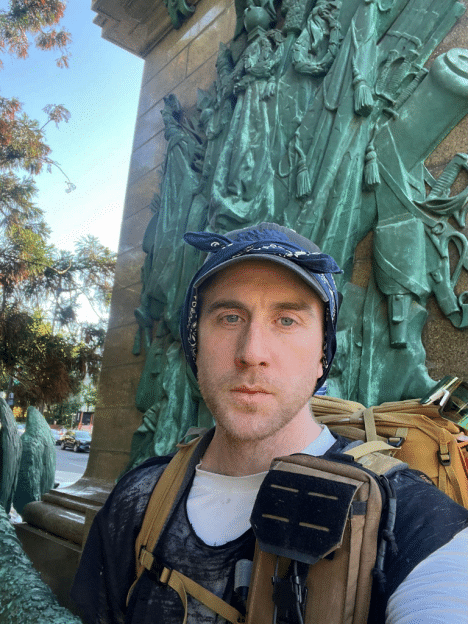
Since beginning pilgrimage work with Brooklyn Quakers in early 2025, I have literally and figuratively followed a tradition that is older than what is known now as the United States. Quakers have been walking pilgrimages on this continent for nearly four hundred years as an act of peace. This simple act continues to be an effective way to step outside of many oppressive, interconnected systems to meet with friends in true intention.
Quakerism has always had much to offer fellow socialists. Our historic mode of governance prioritizes long, thoughtful discernment which necessarily resolves in consensus. Quaker governance serves as the basis for the theory of sociocracy. In what was then known as New Netherland, Peter Stuyvesant famously banned Quakers from practicing their religion. A 1657 petition called the Flushing Remonstrance was a call by residents of the borough for ratified religious liberty. Over a hundred years later, the petition inspired the Founders to include freedom of religion in the Bill of Rights, connecting Quaker society to this essential feature of spiritual freedom in the United States.
The National Peace Walk 2026 follows this tradition of publicly expressing faith as an immovable societal foundation, one that weathers all periods of change. Walking to bring this good news to friends extends from a literal and metaphorical lineage that exists both on this continent, and throughout the world. Dozens of folks we have met along the way speak of the Camino de Santiago, currently experiencing the highest number of pilgrims since the 16th century.
More recently, in our own country, a group of Buddhist monks walked 3,500 kilometers and gained international attention for the cause of peace and understanding. Their walk extended to Sri Lanka after the U.S. phase was finished. The tradition of pilgrimage in the United States in modern times has been upheld by a few notable figures, including Peace Pilgrim, who walked for nearly 30 years, crossing the United States seven times, speaking before crowds and on radio. According to her story, she rested when offered lodging, ate when offered food, and carried nothing except the clothes she wore.
In the days before the United States. celebrated “America250,” the National Peace Walk finally crossed the North Carolina border, leaving only two days of walking to the next Quaker meeting in Raleigh. Those days in Virginia proved to be a challenge unlike the prior 300 miles between New York City and Washington. The heat and fatigue were factors, but the size and remoteness of Route 1 outside of Richmond were staggering at points. On this section, we could no longer count on a nightly station with Quakers, other faith groups, or communities of people activated toward building peace. We saw instead a kind of cultural blight: towns that had emptied after the dissolution of an unsustainable industry or the construction of I-95/85. In earlier days, when we might have stopped at some center of community for rest and water, there was now just a Wawa store, and then at a certain latitude, a Sheetz. We took our overnight rest on an abandoned porch or in the prohibitively expensive, soulless interior of a hotel room.
The act of intentionally meeting with friends at times can feel utterly inaccessible without acquiescing to a number of oppressive systems, installed by the force of convenience. “America at 250” on its face would like to be a celebration of a unity among states, but the lived reality for most in the Covid-era is an encroaching stasis of isolation, even “post” lockdown.
The recent work of pilgrimage by NYC Quakers has been a modern effort to transcend these divides and to meet with friends as companions and partners in the realization of a peaceful world. Our intention as walkers is to reach Minneapolis by November, in order to celebrate the work of residents of the Twin Cities to build resilience under the pressure of full-bore state violence. From where we stand now, in Boone, North Carolina, a walk to Minneapolis could seem like an untraversable distance. What is certain, as it has been revealed to us many times over at this point, is that applied faith shared by community will open a way. The serendipity of the journey will be found by those who set out to meet it.
The post 400 Years of U.S. Pilgrimage: Why This Quaker is Walking Across the Country appeared first on DSA Religious Socialism.

Voter Guide August 2026: Shelby County General and Federal & State Primary Election
The Voter Guide Subcommittee of the Memphis-Midsouth Democratic Socialists of America Electoral & Policy Committee has done deep work to unpack the races in the Shelby County General Election and Federal & State Primary Election, which run early voting from now through August 1 and will hold election day on August 6. To view or download the guide to see who has our recommendation, follow this link to visit https://memphisdsa.org/vote or check out the Voter Guide tab.
Note: The full revised guide was published on July 28, 2026. This guide was updated to include information on candidates in the judicial races.
Read more at Memphis-Midsouth

Weekly Roundup: July 28, 2026
Events and Actions
 Tuesday July 28 (6:30 PM – 8:00 PM) Ecosocialist Bi-Weekly Meeting (1916 McAllister St)
Tuesday July 28 (7:00 PM – 8:30 PM) EWOC Fundamentals of Workplace Organizing (1916 McAllister St)
Wednesday July 29 (6:00 PM – 8:00 PM)  DSA SF Electoral Board x WFP Happy Hour (Teeth Bar SF, 2323 Mission St)
Wednesday July 29 (6:00 PM – 7:30 PM)  Phonebank for the Affordable Housing Guarantee Act (1916 McAllister St)
Wednesday July 29 (6:45 PM – 8:30 PM) Tenant Organizing Working Group Meeting (1916 McAllister St)
Thursday July 30 (7:00 PM – 9:00 PM) ICE Out Orientation (zoom and in person at 1916 McAllister St)
Saturday August 1 (1:00 PM – 3:00 PM) Immigrant Justice KYR Canvassing – Pacific Heights (Raymond Kimbell Playground Park, 1901 Geary Blvd)
Monday August 3 (6:30 PM – 8:00 PM) Homelessness Working Group Regular Meeting (zoom and in person at 1916 McAllister St)
Tuesday August 4 (5:30 PM – 7:00 PM) Social Housing Working Group (zoom and in person at 1916 McAllister St)
Wednesday August 5 (5:30 PM – 7:00 PM) Tenant Organizing Working Group Meeting (zoom only)
Wednesday August 5 (6:00 PM – 9:00 PM) Social Housing Happy Hour (MOTHERSHIP, 3152 Mission St)
Thursday August 6 (6:00 PM – 7:00 PM)  Education Board Open Meeting (zoom and in person at 1916 McAllister St)
Thursday August 6 (7:00 PM – 8:30 PM) Immigrant Justice regular meeting (zoom and in person at 1916 McAllister St)
Friday August 7 (6:00 PM – 8:00 PM) Bloody Sugar: the C&H Strike and Justice for Land Defenders in the Philippines (in person at 1916 McAllister St)
Saturday August 8 (11:00 PM – 2:00 PM) Fundamentals of Tenant Organizing [ETOC] (in person at 1916 McAllister St)
Sunday August 9 (5:00 PM – 6:00 PM) Tenderloin Healing Circle Working Group Meeting (zoom only)
Monday August 10 (6:00 PM – 8:00 PM) Tenderloin Healing Circle (Kelly Cullen Community, 220 Golden Gate Ave)
Monday August 10 (7:00 PM – 8:00 PM)Labor Working Group Meeting (zoom and in person at 1916 McAllister St)

Happy Hour with the Working Families Party
New to organizing? Looking to get more involved? Come to our joint happy hour with the Working Families Party TOMORROW Wednesday July 29th at Teeth Bar, 2323 Mission, from 6:00 – 8:00 PM and meet cool people organizing cool campaigns. The event is all ages AND it’s Teeth’s “Wings Wednesday” so you gotta come out — RSVP here!

Immigrant Justice Know Your Rights Canvassing Event & Social
The Immigrant Justice Working Group will be hosting an ICE Out Orientation session this Thursday, July 30 from 7:00 – 9:00 PM at the office (1916 Mcallister) and virtually over Zoom! This is perfect for if you are interested in learning where to plug in with your local community initiatives and learn how to best utilize your skills, or even just to connect with others if you’re already active!
If you plan to attend either in person or on Zoom, please RSVP here!

Immigrant Justice Know Your Rights Canvassing Event & Social
Join the Immigrant Justice Working Group for Know Your Rights (KYR) canvassing Saturday August 1 at 1:00PM at Raymond Kimbell Playground Park!
We will be distributing red cards and KYR materials to businesses and community members in the Pacific Heights neighborhood.
We will meet at Raymond Kimbell Playground Park on the corner of Geary Blvd. & Steiner St. to receive training and materials before canvassing.
Join us after for a social/debrief session at a local spot and grab food/drinks!
New to canvassing? No worries! There will be a brief how-to training before we go out in pairs or small groups.
Bloody Sugar: the C&H Strike and Justice for Land Defenders in the Philippines
DSA SF is hosting a guest speaker from San Francisco Committee for Human Rights in the Philippines (SFCHRP) to discuss the recent events that connect the strike against C&H Sugar in Crockett, California to the massacre of 19 land defenders and activists in Toboso, Negros Occidental in the Philippines. We’ll dive into sugar’s bloody history, learn about the links in the imperialist global supply chain that bind us together in struggle, and discuss what we can do here in San Francisco.
Join us on the evening of Friday, August 7th in the office at 1916 McAllister St. (RSVP link coming soon!).

Reportback: Tenant Organizing Working Group Provide Support for Socialist in Office Jackie Fielder’s Town Hall
On Thursday, our Socialist In Office Supervisor Jackie Fielder hosted a Town Hall at La Fénix on Mission as part of a D9 listening series. Last Tuesday, DSA members posted flyers throughout the Mission inviting residents to the Town Hall and the Citywide Tenant Assembly in August, and providing information to help tenants know their rights when facing eviction. DSA’s Tenant Organizing Working Group was joined in tabling the event by the Eviction Defense Collaborative, and DSA SF members were in attendance to support and listen to ideas and concerns from working class residents in the Mission.
The room was packed with constituents who shared questions and comments to a panel including Jackie and representatives from the Mayor’s Office, the Department of Emergency Management, the Office of Economic and Workforce Development, SFPD, and SFMTA. Mission residents took the floor and advocated for many important community needs such as funding for peer counselors, mental health and substance use treatment, housing-first policies and funding for affordable housing, and against recent shelter closures and surveillance by Flock cameras. The departments took notes and responded to questions directed at them, including requests for greater transparency and regular reporting. Jackie’s team followed up with residents who still had comments after the event to make sure their concerns were noted.
If you’re interested in showing up to support our Socialist in Office, Jackie’s next Town Hall will be in Portola on Thursday, July 30 from 6:30 – 7:30 PM at the Family Connections Center, located at 2565 San Bruno Ave!

Statement on the Murder of Corey Ruiz
On Wednesday, July 22, four Madison Police Department officers surrounded and executed Corey Ruiz on the corner of Williamson and South Baldwin streets, mere blocks away from where Tony Robinson was murdered by Matt Kenny in 2015. We condemn in no uncertain terms the murder of Corey Ruiz by the Madison Police Department. Regardless of the events leading up to the murder, there is no situation where this is justified. For days our members have participated in demonstrations, protests, and vigils in solidarity with our community.
This is not the first time Madison Police officers have taken a neighbor’s life; the police continue to use excessive force and perpetuate racism and classism with absolute impunity. In March 2015, Madison Police officer Matt Kenny shot and killed 19-year-old Tony Robinson. Despite widespread protests and calls for accountability, Matt Kenny has faced no charges and is still employed by the Madison Police Department more than ten years later. He even trains new officers. Even Tony Robinson was not the first victim of police murder in this neighborhood—in 2012, Paul Heenan was murdered by police on South Baldwin Street, and in 2006, Victor Montero-Diaz was murdered by police at the gas station on Williamson Street.
We stand behind the community’s demands for:
- The immediate arrest of Kiel Baitinger-Peterson and all those accessory to the murder we witnessed on Wednesday afternoon
- That all information found in the investigation conducted by the Department of Criminal Investigation be turned over to the Office of the Independent Police Monitor and Civilian Oversight Board
- Community control over the police.
We demand accountability for Corey’s murder, and for the systems that have led to this point— systems that value property over human life. We demand full transparency, including the immediate release of the names of every officer involved and all available squad car camera and surveillance footage.
These common-sense demands only address this most recent harm done to the community and ensure accountability follows. If we truly want to stop further violence, we must not treat this as an isolated instance but rather a part of a larger structure that perpetuates violence. Instead, we must focus on the kinds of reforms that will prevent future police violence against our communities.
We must demilitarize police departments, redirect funding to public services, and strengthen the Office of the Independent Police Monitor and Civilian Oversight Board to have real community authority over the police. These changes, among others, are steps that will bring us closer to changing the violent carceral system that destroys communities and takes lives. We need to recognize that any reform that does not decrease the power of the modern punishment bureaucracy is no reform at all.
Time and again we’ve seen politicians break promises, make compromises that lead to half measures, and roll back reforms. We’ve seen momentum toward progress stall as soon as the news cycle moves on. Non-profits are limited by their mandate, structure, and fundraising, and advocate but do not deliver. To win our demands, members of the community must get organized and work together.
Support and attend the vigil, connect with your community, and be ready to take concrete action in the coming days and weeks to ensure true accountability and justice for Corey Ruiz.

Statement of solidarity with Puerto Rican independence
The Democratic Socialists of America hold that Puerto Rico’s current territorial status is, unequivocally, a colonial one. We hold firm in Puerto Rico’s right to self-determination and independence. The United States must cede control through an orderly transition—one that cultivates an economically resilient and sovereign nation.
Puerto Rico was occupied by U.S. military forces on July 25, 1898, and has remained a colonial holding ever since. The Puerto Rican people continue to bear the brutal costs. Residents often endure weeks without running water, persistent blackouts and soaring electric bills, rising youth poverty, and population displacement. Meanwhile, the tourism industry, LUMA, and the unelected Junta, continue to profit from this unequal relationship and are responsible for failing to address this ongoing humanitarian emergency .
The colonial system has failed Puerto Rico. The U.S. government carries a profound moral duty to confront this irrefutable truth by allowing Puerto Ricans to exercise their inalienable right to self-determination and independence.
We, the Democratic Socialists of America, stand with the Puerto Rican Independence Movement and urge the following demands:
First, the U.S. Congress must initiate a process of decolonization for Puerto Rico and cede all sovereign powers to a popularly elected government.
Second, the U.S. must assist in a process of transition to full independence. This transition process must support the economic development of Puerto Rico, cancellation of debts, and foster diplomatic relations between Puerto Rico and the U.S.
We reject colonialism outright and recognize that independence is the solution. Colonialism runs counter to every American principle of liberty. That is why we pledge our membership, our time, and our organizational resources to winning this fight in and out of Congress.
DSA stands in absolute solidarity with Partido Independentista Puertorriqueño, Democracia Socialista, Movimiento Victoria Ciudadana, Colectiva Feminista en Construcción, Movimiento Independitista Nacional Hostiano, and all organizations in Puerto Rico committed to decolonization. We condemn all organizations that promote and benefit from the colonization of Puerto Rico such as Partido Popular Democratico and Partido Nuevo Progresista.
Demand action. Demand justice. Demand Independence for Puerto Rico.
Congress bears a moral obligation to act on Puerto Rico—and that moment is unmistakably now.
The post Statement of solidarity with Puerto Rican independence appeared first on DSA International Committee.

An Open Letter to the California Labor Movement

After more than a half century studying, teaching, writing about and participating in the California labor movement, I am completely clear about one simple lesson: when we are united, we win, and when we allow ourselves to be divided, we lose.
This is, of course, not an original idea. We might look to Abraham Lincoln’s “A house divided against itself cannot stand” on the eve of the Civil War as one similar observation among many others along the way. But the difficulty, over and over again, is that powerful forces are always working to divide us, and they succeed all too often. And they are doing it again right now.
This year California’s unions have an unprecedented opportunity to tap the well-deserved anger its members are feeling toward the anti-union Trump administration and its ultra-rich supporters in our state. Two ‘tax the rich’ ballot measures, Prop 3 and Prop 40, will be voted on by the state’s electorate on November 3.
Prop 3 is a currently existing tax on the wealthiest two percent of income earners. Last year it brought over $14 billion into the state treasury to support public education, as well as other public services. But it is temporary. If allowed to expire it will cause devastating reductions in an already-strapped public education system. Prop 3 proposes to make it permanent.

Prop 40 is a proposed temporary wealth tax on the state’s couple hundred billionaires. It would assess a one-time tax, to be paid over five years, on the billionaires’ collective hoard of two trillion dollars—a sum bloated by their federal tax cuts engineered by Trump and his congressional allies. The amount to be raised—one hundred billion dollars—will prevent cuts in Medi-Cal spending that otherwise will throw millions of the state’s poorest families off of their health care.
Neither of these taxes will harm in the slightest the well-off people who will pay them and they will benefit all Californians who wish to be educated and healthy. A no-brainer for the labor movement, yes?
The state’s unions are in two camps supporting one or the other. There are only a handful of unions on board both measures. There are reasons for this, as there always are. Some of the reasons are better than others, but what they add up to is trouble for the state’s working families and the entire labor movement if either of the measures fail to pass.
The obvious direct harm would be to students and patients, but it radiates outward from there to their families and communities. That’s easy to see. How does it harm the state’s unions? In general, unions, when they have their heads screwed on straight, understand the necessity for the rich to pay their fair share of taxes. Without that, the responsibility of supporting social services falls on the shoulders of the working class, union members and non-members alike, who generally are willing to take on their fair share, so long as their employers, large corporations and the rest of the capitalist class are doing so too.
The effort by a small cadre of ultra-conservative ultra-rich to divide and confuse the California working class over this issue has been underway since late last year. The sociopathic greed of a dozen or so megalomaniac tech bros have propelled them to spend an astonishing $125 million against the Billionaire Tax. Their arguments are simple and false, but when you have that kind of money to burn we enter the territory of Nazi Minister of Propaganda Joseph Goebbels’ infamous advice that a big lie repeated enough times becomes true. Mailers, digital ads, right wing think tank “studies” and now an $87 million television buy are demonstrating two things: that the ideas of our contemporary right wing anti-tax propagandists owe much to fascist thinkers; and that the effectiveness of such a campaign is enhanced when it has largely gone unanswered by the proponents of Prop 40 and Prop 3.
Prop 40 proponents haven’t answered in kind because they don’t have that kind of money at their disposal. But they also haven’t shown that they are building the kind of grassroots union campaign—big coalition, major mobilization of rank and file members in phone banks, canvassing and visible street demonstrations; in other words, the best tools at unions’ disposal—that it will take to defeat the billionaires.
Prop 3 proponents haven’t answered because the attacks—so far—have only been against the billionaire tax, and the Prop 3 coalition leaders do not seem to understand that there is a higher principle involved here than the violations of labor coalition-building protocols committed by SEIU-UHW. The higher principle is, quite simply, the general good of the entire California working class—not to mention understanding the damage that will be done to momentum around the country for tax the rich campaigns (most recently successful in places like Massachusetts and Washington state) should the Billionaire Tax be defeated. A defeat will also hurt the chances of future progressive tax campaigns here in California.

IWW leader Big Bill Haywood explained to striking Lawrence textile workers in 1912 that while the AFL organizes “like this”, the IWW organizes like this: a fist. The lesson is still the right one.
In 1912, during the massive “Bread and Roses” strike of textile workers in Lawrence, Massachusetts, Industrial Workers of the World leader Big Bill Haywood spread out his fingers during a speech and told the crowd, “This is how the AFL organizes”, and enumerated the different craft unions organizing separately from one another. He noted that individual fingers could be easily disabled. Combining his fingers into a fist, the miners’ union leader roared, “This is how the IWW organizes”. Acting upon that lesson led the Lawrence workers to victory. But memory within organized labor of that point has been, time after time, victim to a deadly historical amnesia.
The California Federation of Labor Unions meets on August 4 to debate and vote on Prop 3 and Prop 40, among other issues. A vote to endorse both measures is in the interest of every union in the federation and every one of its more than two million members. The delegates to the meeting would do well to heed the words of Haywood and not succumb to narrow trade-conscious interests and the barrage of lies launched by their class enemies. Instead, it’s time for a unified labor movement to lead.
Back to newsletter
How member power won UTLA’s historic contract

UTLA bargaining team members on 4/12/2026.
It’s become tradition in Los Angeles that when teachers strike, it rains. At 3 am on April 12th, 2026, the 150-member bargaining team of United Teachers Los Angeles (UTLA) was still negotiating with Los Angeles Unified School District (LAUSD), with only two days before the planned strike of 37,000 teachers in the second largest school district in the nation. They would be joined by Service Employees International Union (SEIU) Local 99, which represents custodians, bus drivers, and maintenance staff; Associated Administrators of Los Angeles (AALA), which represents middle management such as principals; and DSA-LA in solidarity. The three unions striking together would be more than 70,000 workers.
It is the 26th bargaining session for the 2025-2027 UTLA contract, and it is pitch-black outside in Los Angeles’ Koreatown neighborhood, with thousands awaiting news of whether their daily lives will be upended in just two days. The walkout would have been the union’s third strike in seven years, following a six-day strike in 2019 and a three-day solidarity strike with SEIU Local 99 in 2023. Before those two strikes, UTLA had not struck since 1989.
Just before 4 am on April 12th, the UTLA bargaining team came to a tentative agreement (TA) with the district administration after more than 14 months of negotiations. Later that day AALA followed suit with its own TA, and at 2 am on April 14th, just six hours before the planned three union strike, SEIU Local 99 reached its own TA with the district. By maintaining a credible strike threat, UTLA won a historic contract that fixed broken salary scales for the first time in decades; secured an average salary increase of 13.86%, with a minimum increase of 8%; established paid parental leave for the first time; protected workers against subcontracting; preserved Black Student Achievement Plan (BSAP) funding; and won breakthrough Special Education agreements, among many other gains—all without actually striking.

Moments after TA is reached on 4/12/2026, Meredith Schafer, UTLA Research Director (left), Cheryl Coney, UTLA Executive Director (center left), and Brian McNamara, UTLA Organizing and Representation Director (center).
“We averted a strike. We shot down the district's arguments with figures that backed up what we've been saying all along,” says Gloria Martinez, now UTLA president. (She was UTLA treasurer and a lead officer for the UTLA bargaining team during the 2025-2026 contract negotiations. She was also a DSA member and plans on rejoining, she says; she’s just been busy.)
What Martinez is speaking of is LAUSD’s narrative of austerity, used during every cycle of contract negotiations for years. Regardless of how good or bad the economics of the district are at the time, such as having over $5 billion dollars in unrestricted reserves as a “rainy day fund” at the end of the 2024-25 fiscal year equaling 35% of total spending, the CFOs of the district sow fear and doubt. They mainly do this through economic projections that in one year, two years, three years, the district will fall off a fiscal cliff, and so they claim their hands are tied. To be fiscally responsible, the district cannot spend another dollar more, if their economic projections are to be believed.
“When you have a multibillion-dollar organization like LAUSD who can invest in PR machines that use budget figures to scare off folks into believing they can't afford what workers are demanding, I think that it creates confusion and hesitancy and allows for that fear and uncertainty to creep in,” adds Martinez.
The figures UTLA mustered to combat the administration’s scarcity and austerity arguments came chiefly from the UTLA research team, UTLA staff members who were with the UTLA bargaining team during the contract negotiations. LAUSD administration argued it could not spend a dollar more because when it looks toward the future, it expects that it will not have enough money to afford what the union is demanding. The UTLA research team investigated how accurate LAUSD’s past financial predictions were. California school districts are required to do a three-year projection of their budget, and when you consider LAUSD’s projections for where they would be three years out, every year from the 2013-2014 school year through 2024-2025, a pattern emerges. Historically, on average, the difference between what the district projects and what they end up with one year later is off by 57 percent. Two years out they are off by 268 percent and three years out they are off by 888 percent.
This would be similar to a friend asking to borrow $2,000 from you because, they say, they are $2,000 in debt, only for you to later discover that they actually had $16,000 in the bank. They keep saying this to you every year. For 10 years. Understanding this track record deflated much of the fear and doubt the UTLA bargaining team first experienced when the district’s negotiation team began presenting how badly their finances would deteriorate over the next three years if it agreed to the union’s proposals.
Though the UTLA research team is essential for countering the administration’s claims of scarcity, it was not the only reason for UTLA’s victories.
“The main reason we were able to win without going on strike this time was that we had a credible strike threat. We've become an organizing and strike-ready union through the efforts of many people who have helped transform UTLA since 2014, including members of the Educators Organizing for Power (EOP) caucus and DSA members,” says Ryan Andrews, a UTLA bargaining team member, EOP member, and DSA member. “We talk with every member of the union, understand the issues they care most deeply about, and involve them in organizing. That's how we built the power to cut through the district's austerity narrative.”
A union which for 30 years before 2014 had become a low-participation organization is now a union which is known for winning its contract through being strike-ready, even without actually going on strike. This change began in 2014 when Alex Caputo-Pearl, a DSA member, and the Union Power caucus slate running with him were elected to leadership in UTLA. The new leadership’s years spent rank-and-file caucus organizing with Chicago’s Caucus of Rank-and-File Educators germinated a change in UTLA. Five years later in 2019, under Caputo-Pearl, UTLA would go on strike alone for 6 days in the rain and win pay increases, first-ever enforceable class size caps, more nurses and librarians, an LAUSD call for a moratorium on charter schools, a first-ever Community Schools initiative, and racial justice victories, among other gains.
Four years later in 2023, this change in the union proved durable as the next UTLA president, Cecily Myart-Cruz, led UTLA to strike in solidarity with SEIU Local 99 while UTLA was in its own negotiations with LAUSD. After striking for three days again in the rain, UTLA and SEIU Local 99 won their contracts, with UTLA winning significant pay raises, further lowering of class sizes, enshrining the Black Student Achievement Plan (BSAP), and an expansion of Community Schools initiatives into the UTLA contract, among other victories.
Three years later, UTLA has won again, and though there was no strike for teachers to march through a downpour, I and others in the bargaining team at 1 am got caught in the rain just hours before the TA, keeping the tradition alive and well.
“What we can learn from this contract is listening to what is felt throughout the city, the issues that impact the workers and our community,” Martinez says when I ask what lessons the union should carry into 2028, when UTLA and many other unions across the country will again negotiate contracts. “We have a system that is failing them. Standing up for the issues that are deeply felt allows us to consolidate that collective power, it allows us to change the narrative.”

Over 30,000 for UTLA, SEIU Local 99, and AALA 3/28/2026 at Grand Park.
Reflections on the Oliver Ma Campaign for Lieutenant Governor

Canvassing in Irvine.
Brief overview
A candidate no one had heard of entered a statewide race no one really knew about and ended up with more than half a million votes. Oliver Ma’s campaign for Lieutenant Governor was California DSA’s first statewide candidate race and will not be the last.
Across the board, people were excited about Oliver and about his platform, too [see accompanying article with chapter campaign reports]. Affordable housing, free healthcare, abolishing ICE, ending the genocide in Palestine—a platform familiar to us as socialists, but one that many voters are just now warming up to.
This race was a familiar story: we were up against long-serving politicians and candidates with deep pockets; we needed a mass movement of organized people to challenge that.
With the support of DSA members, DSA chapters, and committed volunteers, this campaign showed that California voters, more than 620,000 of them, are supportive of Democratic Socialism and are ready for change.
Lessons Learned

Oliver’s campaign was heavy on social media.
Going viral on social media is not enough to win elections, but it can be an extremely valuable tool when used intentionally.
You may have seen Oliver on TikTok, Instagram, or even on one of your favorite streams talking boldly about Democratic Socialism and the importance of building a government that works for people, not corporations. Nearly every single volunteer I met or leader I trained certainly told me they had seen him online. And, of those people, many told me this was their very first time engaging politically. These volunteers helped us reach out to hundreds of thousands of voters across the state and they might not have ever even known about this race if it wasn’t for social media.
Motivating someone to turn out and vote, especially if they do not usually vote or if they feel abandoned by the current government, is often a more challenging task. It requires more than just seeing a few cool videos on the feed, so you can’t count only on social media if you want to build power (and win). Ultimately it was the conversations we had with voters in their communities, and on their phones, about the issues that matter most to them. Of course, those conversations are much easier if they have seen your candidate on social media before, but that alone is not enou

Crowd canvassing at No Kings in downtown Los Angeles.
The things we are fighting for as socialists are broadly popular, even if the term “socialism” is not. We talked to voters all across the state in all different communities, but we so often heard the same issues coming up. Housing costs are rising. Healthcare is unaffordable. Everything is unaffordable. People should be safe in their neighborhoods, at home and abroad. What we have going now really isn’t working for working people.
This gave us the chance to talk about how corporations and billionaires are often at the root of all these issues—and then about how Oliver was going to use the powers of this office to improve conditions for working people and tackle the issues impacting their daily life.
As socialists, we can diagnose that capitalism is broadly at the crux of nearly every problem, but it’s not always easy to have that conversation.

The author with Oliver at an “ICE Out” protest and march in L.A.
Running candidates who are Democratic Socialists allows us to talk about these broadly popular ideas. Then electing those candidates to positions of leadership, and power, can fundamentally change the lives of the working people in the communities they serve.
Mayor Zohran Mamdani’s New York is proof that it is possible, and those wins on the east coast have reverberated across the country.
When voters saw “DEMOCRATIC SOCIALIST”at the top of Oliver’s literature they often asked us, “Like Zohran?”. This easily opened the door for us to have a conversation about DSA and socialism that might have been more challenging or less explicit otherwise. If voters didn’t know Zohran, or even if they were not sure about the whole DSA thing, we were still able to have those important conversations with them about their struggles and our common enemies.
We might not have ever had these conversations with our community members if we did not show up in their neighborhood to knock on their door and talk about this election and this candidate.
The time to prepare for the next election cycle is now
Building and refining chapter infrastructure and process takes time, but time is always of the essence during an election year. Start having conversations now about your chapter’s endorsement timeline, process, and electoral program. Consider what it would take not only to endorse a candidate, but also to win. Does your chapter have tools you need? Do your members have the skills they need? If not, what can you do now to be prepared for the next electoral cycle?
Socialism continues to gain momentum. We have the opportunity to build power for working people at the local and federal level; but it will take an organized mass movement to win.
Back to newsletter
Oliver Ma campaign built chapter electoral capacity
California Red asked several chapters to assess their participation in the Oliver Ma campaign for Lieutenant Governor, California DSA’s first foray into a state constitutional officer race. Their responses give us snapshots of the challenges and gains experienced in emerging chapter electoral structures at a time of rapid membership growth and new leader development.

Inland Empire DSA knocked 600 doors for Ma.
Inland Empire
The Inland Empire chapter of the Democratic Socialists of America’s electoral committee had not been active for nearly three years, but the energy and the excitement that brought in a flood of new members eager to reproduce the work done in New York needed to materialize here in our chapter. Thus arose from the collective imagination of our membership a yearning, an ambition, a dream—to build something, as workers have done throughout time immemorial, building a machine… the canvassing machine.
The canvassing machine became a collective project and an inside joke that inspired our membership to think of the endeavor as something we were building and refining through grass roots organizing. In total we knocked over 600 doors in Perris and Riverside.
Overall, the campaign was a success for our chapter. Although we fell short on Election Day, the campaign gave our relatively new Electoral Committee invaluable experience running a serious electoral effort alongside a strong democratic socialist candidate. Members were highly engaged throughout the campaign, gaining practical organizing experience through canvassing, phone banking, and having meaningful conversations with voters about the issues and our vision for the community. Those experiences strengthened both our members' skills and our chapter's capacity to run future campaigns.
The campaign also highlighted several important areas for growth. We learned the importance of beginning our organizing earlier, establishing clear leadership roles, and building stronger campaign infrastructure from the outset. These are foundational lessons that will make our future electoral work more organized, efficient, and effective.
Perhaps most importantly, the campaign helped grow our chapter. We recruited new members directly at our canvass launch locations, and many people were motivated to get involved after seeing a local DSA chapter actively supporting a viable democratic socialist campaign. While Oliver did not win the election, the campaign was far from a loss. It strengthened our chapter, developed new organizers, expanded our active membership, and left us better prepared to run even stronger campaigns in the future.
Said one Inland Empire member, Crystal: “Canvassing for Oliver Ma was heartwarming. It was a unique experience in that the candidate we canvassed for actually came out to knock doors with the people! Amidst the backdrop of an otherwise fascistic and suffocating reality, there are people willing to commit their hearts and time for humanity. It’s a beautiful thing to see.”

Long Beach DSA Electoral Politics Committee members gather to phonebank for Oliver Ma.
Long Beach
DSA-LB is proud to have endorsed Oliver Ma for Lieutenant Governor and campaigned for his candidacy in Long Beach. The June 2026 primary marked our chapter's first statewide endorsement, first Voter Guide, and our Electoral Politics Committee's first significant experience with electoral campaigning, canvassing and phone banking. Although Oliver's election outcome wasn't what we had hoped for, campaigning for Oliver significantly boosted our chapter's electoral politics skills, which we are carrying forward into the November election. DSA-LB is now campaigning for the Billionaire Tax initiative; we have built a Billionaire Tax Now ("BTN") Working Group and are putting the skills we honed for Oliver into action for BTN and future campaigns. We're grateful to Oliver for running and can't wait to see what all of us in California DSA do next.

Orange County DSA and UAW Local 4811 members gather to canvass in Irvine.
Orange County
Oliver Ma’s campaign came at a time when our chapter was rebuilding our electoral committee from the ground up. When we held the candidate endorsement forum for Oliver, we saw new faces excited to ask questions of a candidate they completely aligned with. One of the campaign’s strengths that we really benefited from was its goal to recruit new DSA members and engage them in electoral work. Through the campaign, we not only grew our electoral committee, but the chapter as a whole and new leaders began to emerge. The campaign provided the tools for many of us to learn how to canvass and phone bank and many members who had never knocked on doors for a candidate before participated in canvassing. Oliver’s mission and his platform made it easy to talk to voters in our community, and we started to have hope that California could be a place where massive change could take place.
Kern County
One of our biggest lessons from this election was simple: be early.
If possible, avoid entering an election cycle while still in Organizing Status. By the time we were ready to engage seriously, other organizations had already endorsed candidates, including candidates we believed offered less to the working class than Oliver. Many of our members and the broader activist community were also already committed to other campaigns.
Kern County also needed to start earlier and organize more intentionally around the campaign. As campaign captain, I did not do enough to build internal enthusiasm, recruit volunteers, and turn an endorsement into sustained member participation.
At the same time, we were trying to bootstrap an electoral operation while still building the chapter itself. We were developing structures, relationships, and organizing capacity in real time.
Those are growing pains, but they are also lessons. Endorse early. Organize early. Assign clear responsibility.
For us, an endorsement is not an aspirational checking a box, but a mandate to put momentum behind what we believe in.
Contributors:
Odeh G. and Lawrence C. are members of Inland Empire DSA. Odeh is chapter co-chair.
Sidra G. is a member of DSA Long Beach Electoral Politics Committee and serves as Communications Coordinator of the Chapter.
Kathryn M. is an At-Large member of the Orange County DSA Steering Committee.
Robert F. is on the Kern chapter Steering Committee.
Jack R. provided editorial support.
Back to newsletter
Justice for Lyle Prijoles and the Negros 19!
On April 19th, Lyle Prijoles, a long-time Bay Area organizer and SFSU alum, was killed by the Armed Force of the Philippines (AFP), in Toboso, Negros Occidental, Philippines. The AFP displaced hundreds in Negros and massacred eighteen others, including a fellow Filipino American organizer from Washington, Kai Sorem, and Filipino journalists, students, organizers and youth, many of whom were in Negros to report on state repression and the plight of peasants in the area. DSA SF is heartbroken and enraged by these murders, by the loss of a dedicated comrade and member of our community, by the continued exploitation of and violence against the indigenous people of Negros, and by all of the horrors that imperialism continues to inflict on workers across the globe.
DSA SF recognizes that Lyle’s work selflessly organizing for the oppressed in the Philippines and for the restriction of US funding for the AFP exemplifies our positions advocating for the end of imperialism and for the rights of the working class to build a better world. We recommend reading more about his work and life in this statement by the International Coalition for Human Rights in the Philippines (ICHRP).
The United States has not only been a major source of funding for the AFP across multiple administrations, but also regularly performs military exercises with them. The largest of these, the annual Balikatan, took place from April 20th until May 8th this year, immediately after the AFP murdered Lyle. While the US has an endless supply of tax dollars for foreign militaries like the AFP or IDF, even as these forces kill Americans and terrorize poor, innocent people without any recourse, our government has little to offer those of us here at home needing housing, food, healthcare, or education. This is not a mistake; we exist in a system of capitalist exploitation that depends on the continuation and escalation of this existing arrangement, reliant on the ability of the US and its allies to kill whomever they so desire. Without this ability, the US would be unable to continue its project of imperialist resource extraction in the Philippines and elsewhere, and the benefits for the corporate class – lower costs, higher growth, and increased profit – would cease.
DSA SF echos ICHRP’s demands to:
- Hold an immediate and independent investigation into the AFP’s massacre on April 19th in Negros Occidental;
- End U.S. support and funding for the Marcos Jr. administration, as well as U.S. military aid to the Philippines.
You can sign a petition to amplify these demands to the U.S. State Dept. & U.S. Embassy in the Philippines at https://tinyurl.com/negros19-petition.
We stand in solidarity with our kasama from the Bay Area to the Philippines in the continuation of this 400-year struggle of the oppressed against the land-owner and slaver class. We also call on those interested to attend upcoming actions in solidarity with Lyle, the Negros 19, and everyone continuing to suffer under this imperialist regime. You can find more information here:
https://www.instagram.com/defendnegros.norcal
We often say that a better world is possible. Lyle lived this ethos through his actions, through his tireless resistance, organization, and dedication to the most oppressed. May his memory and the memories of all those who stand against oppression be a reminder and inspiration for us all.