By restricting strikes, Princeton silences workers’ free speech
Published in The Daily Princetonian.
Free speech is understood to be a central tenet of academic life at Princeton. Members of the University across the political spectrum have considered how free speech can and should be upheld on campus while maintaining a safe environment. But these conversations have failed to include an essential part of our campus community: workers. Until the University removes the ban on worker strikes, its commitment to free speech will remain hollow.
Members of the Service Employee International Union (SEIU) Local 175 (a union on campus that includes dining hall, custodial, and landscaping staff, among others) are unable to fully access their right to free speech. Workplace discussions about organizing are limited, and their freedom of expression is sharply restricted as well. Article 35 of their contract with the University prohibits the Union and employees from participating in “any strike, sympathy strike, work stoppage, concentrated slowdown, refusal to cross any picket line or interrupt work in any other way.”
Article 35 is justified under the University’s Statement on Freedom of Expression, which protects free speech unless it is “directly incompatible with the functioning of the University.” The University’s statement claims this is a “narrow exception to the general principle of freedom of expression.” However, strikes are one of the most meaningful and impactful practices of free speech.
Free speech has played a vital role in unionization and workers’ rights movements. In the early 20th century, the Industrial Workers of the World (IWW), an organization that advocated for workplace democracy through general and industrial unionism, engaged in a series of “free speech fights.” Members of the IWW spoke out and organized strikes across the United States, often resulting in their arrest. Many organizers refused to be released from prison and demanded a trial as a platform to advocate for both free speech and the right to strike and unionize.
Working conditions improved during the Progressive Era as the federal government was forced to make concessions to labor organizations in the face of strikes and other forms of union activism. For example, in the Bread and Roses Strike of 1912, mill workers who were predominantly immigrant women went on strike in Lawrence, Massachusetts, after their wages were decreased. 23,000 workers went on strike and almost 20,000 were on the picket line. Ultimately, the Bread and Roses Strike increased not only their own wages, but the wages of textile workers across New England.
Labor activism has played a critical role in achieving many of the labor protections which we take for granted, including weekends, overtime pay, and the elimination of child labor. Without the ability to strike, SEIU Local 175 is significantly disempowered in their contract negotiations with the University.
To investigate the state of worker satisfaction on campus, the Young Democratic Socialists of America (YDSA) at Princeton surveyed 116 union service workers during the Spring 2023 semester. On one hand, the survey found that most workers seemed grateful that the University offered relatively good non-wage benefits. However, as expressed by Abdul-Bassit Fijabi ‘24 and David Beeson ‘26 in a separate piece, surveyed workers have consistently expressed concerns; for example, some noted that they are woefully underpaid – especially in a time of high inflation – as staffing shortages and a sense of alienation plague many union shops on campus.
SEIU Local 175, which employs over 700 employees at Princeton University, makes active efforts to improve working conditions and wages for unionized workers. As one worker expressed, the union “[f]ights for all employees and has… sav[ed] employees’ jobs”; and as another notes, the union has “done well with getting us increased raise amounts over the past couple years.”
Yet, these aims are severely limited by the imbalance of power in the contract negotiations between the University and the Union, particularly when the University bans free expression in the form of a strike.
In the United States overall, unions consistently demonstrate strong benefits for workers, including up to a 20 percent income premium compared to similar non-union workers. Unions, moreover, demonstrate comparable lifetime earnings gains to those of a college degree despite earlier retirement, with a major part of the causal mechanism being the strike. As demonstrated by economist David Card, strikes in the US have historically had significantly positive effects on unionized workers’ wages, and such strikes were deeply intertwined with empowered labor unions.
Within the University of California system, this freedom of expression enabled educators to gain substantial improvements to students’ education quality and their workplace conditions, with 48 percent higher minimum wages for teaching assistants and 61 percent for graduate students. In 2022, even the mere threat of a strike among Kaiser Permanente nurses resulted in major improvements for both workers and patients, with 22.5 percent higher pay and improved staffing to provide improved patient care. More recently, though the fight continues, the Rutgers strike enabled faculty and graduate students to make strong gains, including 14 to 44 percent higher wages, after the Rutgers University administration simply refused to make reasonable concessions for its employees to see decent compensation for their contributions, by extension ensuring that educators can better serve their mentees.
With the no-strike clause in Article 35, SEIU Local 175 and the workers it represents have less power in their negotiations with the University, as they lack one of the most “powerful tool[s] for any union [to] express its voice,” as put by an anonymous employee. If the University disagrees with a demand, the union cannot effectively use its leverage to encourage the University to listen to workers.
This unconscionable restriction sharply contradicts the University’s romanticized rhetoric about its free speech policies, preventing workers from freely expressing themselves. Free speech is an essential value that must be accessible to everyone, including workers and including for expression that challenges Princeton University, if it is to truly value free expression. Even some past Supreme Court rulings have protected the right to strike on the grounds of protecting workers’ freedom of expression, such as Thornhill v. Alabama (1940) and NLRB v. Washington Aluminum Co. (1962).
Although workers are severely limited in the extent of free expression permitted by the University, students do have the ability to platform the unheard grievances of workers. By acting in solidarity with the employees who sustain our education and living as students, we can show that students will not accept the University’s neglect and disrespect of workers’ needs and free speech principles.
We encourage you to sign on to student groups’ petition for the University to address campus workers’ needs. Additionally, please join YDSA on May 1st to amplify workers’ grievances as a part of Unidad Latina en Acción’s May Day Rally, starting at 112 Witherspoon St on May 1 at 6:00 pm.
Lucía Armengol ‘26 and Bryce Springfield ‘25 are members of Young Democratic Socialists of America at Princeton. The views expressed here do not necessarily reflect those of SEIU 175. This article was written alongside another in a series on campus labor.

New Jersey Workers and Tenants Fighting Back
We're crossing the Hudson River once again to speak to our socialist comrades fighting for workers’ and tenants’ rights in New Jersey. We’ll hear live from Isaac and Julia of the Right to Counsel campaign in Jersey City, now the priciest city in the nation, on their organizing to guarantee representation from an attorney for all tenants facing evictions and other housing issues. We also speak to Deepti, an undergraduate student at Rutgers University, and Sarah, a member of the grad union’s bargaining committee, on their recent and historic strike and what’s next for workers at the largest university in New Jersey.
To learn more and get involved with the Right to Counsel campaign in Jersey City, visit righttocounseljc.org.
Follow Rutgers AAUP-AFT at @ruaaup and Rutgers One Coalition at @r1coalition.

May 6, 2023 Voter Guide
There are two San Antonio DSA endorsed candidates on this guide and one proposition: Jalen McKee-Rodriguez in City Council District 2, Teri Castillo in City Council District 5, Prop A: San Antonio Justice Charter.
Candidates/propositions must seek the endorsement of SADSA and our general membership votes on the decision to endorse. Several community members have reached out to SADSA for a voter guide, so we have created one. It is by no means expansive and does not cover every race in our area, but we hope this can help inform your decisions if you’re looking to a socialist organization for electoral advice.
Our struggles go beyond the ballot box, but it is a site of struggle that we cannot withdraw from, we can take it back if we fight together. Join San Antonio DSA.
If you have any questions or comments, please don’t email SanAntonioDSA@gmail.com.
In Bexar Co. you can vote at any voting location. You can go to the Bexar Co. Elections Department website to find voting locations, hours, your individual sample ballot and more.
City Council Landscape
It’s true the highs of 2021 have worn off. No matter how you slice it, City Council will be lurching to the right for the next two years. The 2023-2025 City Council will still be made of mostly centrists, but things just feel worse this time around. This Council has made historic investments though American Rescue Plan Act (ARPA) decisions, Inflation Reduction Act (IRA) and Bipartisan Infrastructure Law (BIL) funding, and the largest municipal bond in history, but the vibes are most certainly fucked.
There are a few bright spots in union and tenant organizing, but efforts desperately need to be ramped up to exert political pressure before monumental races in 2025. Alongside an open mayoral election, District 4, District 6, District 8 and District 9 will likely be open, if Councilmember Courage (D9) can secure a fourth term this year. The 2025 races will be on the heels of what will certainly be a very entertaining, and likely devastating, Presidential cycle that will most definitely change organizing landscape and conditions.
We sincerely hope that no matter what happens on May 6th and over the next two years, you’ll commit to joining an organization (hopefully DSA dsausa.org/join) and start organizing. Regardless of where you see yourself “on the Left,” your politics are assuredly not reflected across local elected offices…but they should be, even a glimpse! Our Voters Guide is admittedly a bit bleak, no candidates aside from our endorsed candidates are receiving a recommendation before the runoff. We understand this might not really help people who want to vote, but don’t know for whomst. Unfortunately, the who this cycle is mostly anti-Prop A, Chambers of Commerce-types who all say generally the same thing. A total lack of political imagination fueled by a void of community organizing, being filled by (hopeful) careerist politicians. Two years ago, we fought to get Teri and Jalen elected to City Council. This year, we will make sure they stay, and two years from now we must get them comrades on Council.
Organize where you work, organize where you live, and let's organize for a better San Antonio.
UPS Teamsters Gear up for the Contract Fight of a Lifetime
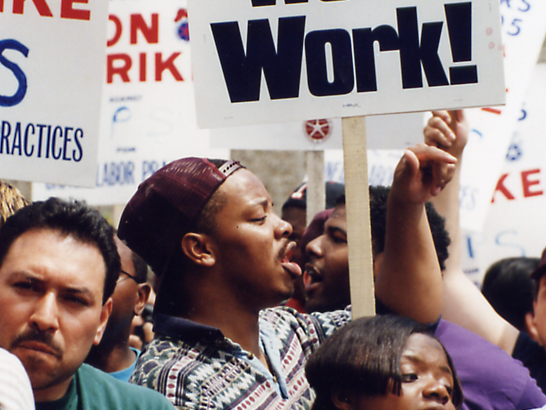
Many of us frequently interact with United Parcel Service (UPS) workers in our daily lives. You see them driving down your street in their emblematic brown trucks. You count on them to deliver birthday gifts to far-flung family members. You may even chit-chat with the UPS worker who regularly delivers packages to your door. UPS is the third largest company headquartered in Atlanta, and it employs nearly 400,000 essential workers who are responsible for transporting 25 million packages and documents daily, across 220 different countries and territories. Millions of us rely on the hard work of UPS drivers and warehouse workers. But did you know that these workers are currently gearing up for a critical contract fight to win better wages, hours, and respect on the job?
All 350,000 non-management UPS workers throughout the U.S. are covered under a national contract, known as the National Master Agreement (NMA), that the International Brotherhood of Teamsters (IBT) has with UPS. This contract governs their wages and working conditions. Some UPS workers — but not all! — are also covered by a local “supplement,” which is a second contract negotiated by local or regional bargaining committees that often has stronger language than the NMA. So while all UPS Teamsters have some baseline protections, there is a lot of variation in the level of protection members receive depending on location. That’s why it’s crucial to have a strong NMA.
And guess what? The NMA is currently up for renegotiation, which is a huge opportunity for UPS Teamsters trying to strengthen their contract. It will expire in just a few months, on July 31, 2023. This time around, IBT is being led by a newly-elected coalition of militant reformers, including General President Sean O’Brien. They’re done making concessions, and if UPS does not end two-tier driver jobs, raise pay for part-time workers, and give in on other key issues, the UPS Teamsters plan to strike nationwide on August 1, 2023.
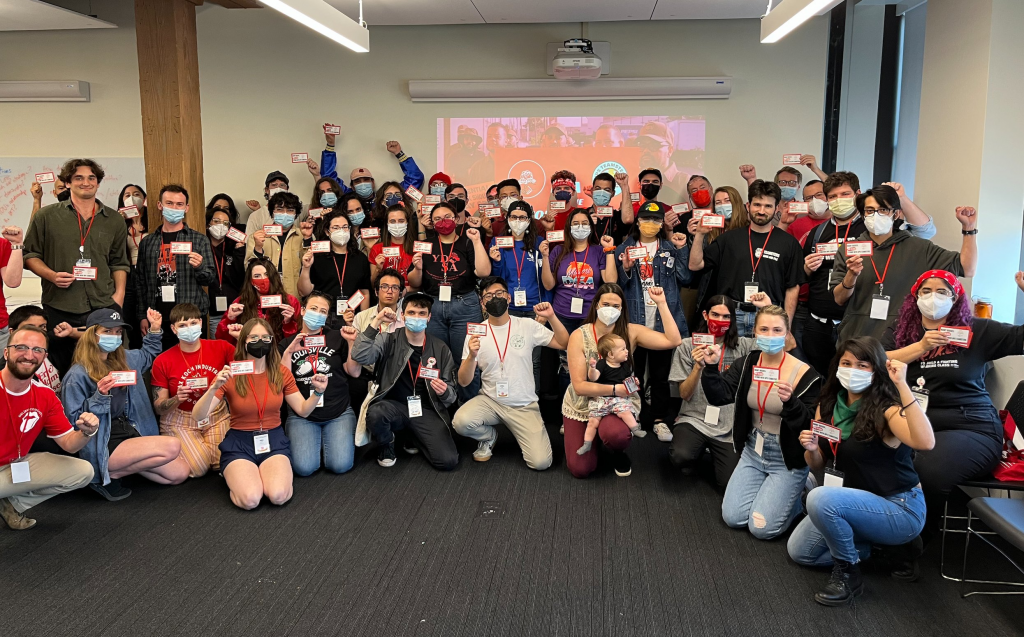
DSA is ready to go all in on this fight! Last weekend, DSA labor and electoral organizers from all over the country gathered in Chicago to announce that 71 and counting DSA electeds have signed on to support the UPS Teamsters this summer. Ahead of July 31, we’re gathering the support of members, our coworkers, and the larger community to stand with UPS Teamsters on the picket line when the time comes. We’re counting on YOU to get involved, sign the pledge, and take a moment to learn what this struggle is all about!
When was the last UPS Strike?
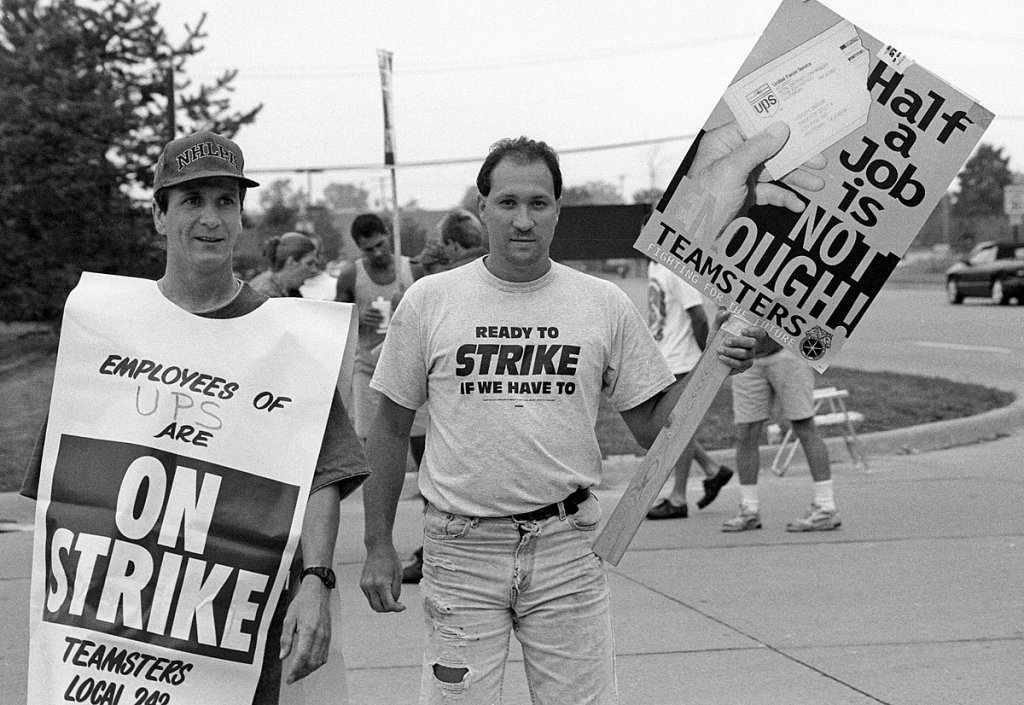
The last UPS Teamsters strike took place in August 1997, during which 185,000 UPS workers went on strike for a better contract. This was a pivotal moment for the U.S. labor movement. The strike lasted 15 days and cost UPS hundreds of millions of dollars. The company admitted that fears of even bigger losses led them to finally agree to IBT’s demands. In other words, the Teamsters showed their company and the world that, when well-organized and well-supported, workers hold the power. IBT won pay increases for part-time workers and drivers, secure pension plans and increased benefits, the conversion of 10,000 part-time jobs into full-time ones, and more.

Strikes have always played a vital role in the American labor movement, but striking actions have declined greatly in this country over the last four decades. Data from The Bureau of Labor Statistics shows that 1,796,000 workers were involved in major work stoppages in 1974. That number hit a low in 2009 with just 12,500 workers participating in major work stoppages. Major strike activity saw a 35-year high in 2018 and 2019, according to Economic Policy Institute. Most recently, in 2022, 120,600 workers were involved in 23 major work stoppages, which was a nearly 50% increase from 2021. Though striking is becoming more popular and union approval rates are increasing in the U.S., UPS hasn’t dealt with a strike in over 20 years. The company is likely unprepared, but the Teamsters aren’t. IBT is ready to stand firm on its demands.
Teamsters’ Contract Demands for UPS Workers
As members of DSA and the Atlanta community gear up to support UPS Teamsters in their contract fight, it’s important to know what workers are fighting for so we can uplift their demands and spread the word! Here are a few of the most urgent issues that will decide if the Teamsters launch the largest strike in recent American history and why each demand is meaningful.
No more two-tiered driver classifications
The 22.4 full-time worker tier was created by the IBT’s 2018 contract with UPS, which was negotiated by former IBT General President and business unionist, James Hoffa Jr. This tier is made up of mostly new drivers who do the same work as more senior drivers — classified as regular full-time package car drivers (RPCD). RPCD pay tops out at $41 per hour, but 22.4’s pay ceiling is $6 per hour less. In addition to lower pay, 22.4s have much less control over their schedules than RPCDs, which leads to high turnover rates. 22.4 drivers deserve the same pay and protections as RPCDs.
Higher pay for part-time workers
Despite what you may assume based on how often you see UPS drivers out and about, most Teamsters at UPS are not drivers. Over half work inside distribution facilities, and many of those workers are part-time. These part-time workers play a vital role in making sure UPS runs smoothly, and they deserve to be compensated fairly for their significant contributions. Starting part-time pay must be increased to above $20 an hour and catch-up raises must be given to existing part-time employees.
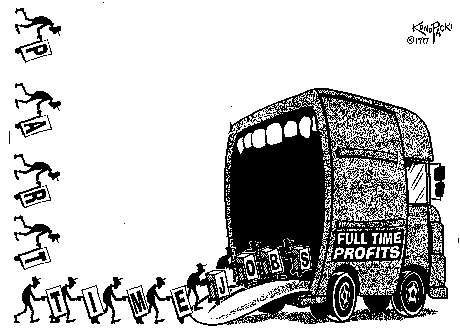
UPS must also end its use of Market Rate Adjustment pay discrimination against part-time workers. MRAs can take the form of hourly rate increases or weekly bonuses and can cover a whole geographic area, a single center, or just certain shifts. By using MRAs, UPS has raised the wages of some workers without implementing raises across the board. The use of MRAs divides unions by pitting senior workers against new hires and even members at one building against another.
More full-time jobs
UPS needs to create more full-time 22.3 jobs, which are inside jobs doing tasks like sorting packages, loading and unloading semi-trucks, and more for 8 or more hours a day. The many part-time workers who are so critical to how UPS runs should be afforded more opportunities for reliable, full-time work if they want it.
No more excessive overtime
Package drivers need stronger 9.5 rights, or the right to cap work at 9.5 hours, three times a week. All people deserve a life outside of work. At UPS, however, employees are often forced into working six days a week. Workers refer to this as the forced 6th punch. Workers who want overtime hours and pay should have the choice to pursue that, but it should be just that — a choice.
Job security for feeders and package drivers
Feeder drivers are usually workers who drive semi-trucks from warehouse to warehouse. UPS sometimes diverts this feeder work to nonunion carriers. It’s time to put an end to the subcontracting of feeder work.
There must also be stronger protection for the jobs that are being eliminated by Access Point and Surepost. Access Points are local businesses that serve as drop-off and pick-up locations for people sending or receiving items through UPS. The company utilizes Access Point as a tactic to cut costs. Surepost is an economy service offered by UPS that delivers items through the USPS. Both render UPS drivers unnecessary, which cuts back on potential jobs.
Video camera and harassment protection
In recent months, there has been a push from UPS to install driver-facing cameras inside vehicles. The introduction of surveillance systems is made even more egregious by the fact that many company vehicles are not even properly outfitted with air conditioning, which has led to hospitalizations for drivers, and in one case, even death. Stronger language to protect workers from this kind of company harassment — including financial penalties against UPS for any violations — must be put in place.
Why Atlanta DSA stands with UPS Teamsters
As socialists, we’re committed to standing with the UPS Teamsters every step along the way of their contract battle because we believe that building power in the workplace is essential to building a better, more democratic economy and society for all working people. The entire working class must stand together with rank-and-file UPS Teamsters in this historic fight to show large corporations like UPS that when workers overcome divisions and unite as a class, we win!
As this is the largest private sector contract in the nation, IBT’s upcoming fight is sure to have a ripple effect in union organizing across the country. Workers make up the majority of the population and create all value in society, but in the U.S., we are highly unorganized with only 11% of U.S. workers represented by a union. To ensure the momentum continues, we should bring everyone into this campaign and work to elevate workers’ demand in a way that helps grow class consciousness among all workers. This campaign is a crucial opportunity to win not just a great, hard-earned contract for UPS workers nationwide, but to send a message to the working class: strikes get the goods! If UPS refuses to concede to workers’ demands and they decide to strike, workers far and wide will see in real-time the power they hold.
How to support UPS Workers
Just like the Teamsters, DSA is asking members and supporters to get STRIKE READY! Sign the Strike Ready pledge and commit to standing in solidarity with IBT UPS workers this summer as they prepare for the biggest potential strike this country has seen in decades. Get updates on upcoming #StrikeReady events this summer, including educational panels, picket line trainings, rallies, and phone banks. Plus, check out the information we’ve put together on the contract fight at atldsa.org/ups-solidarity.
Talk to your union members, coworkers, friends, family, and neighbors about the potential strike! Get them to sign the pledge, attend a phone bank, or join you on the picket line in August. When the working class stands together to fight, we win!
After you’ve committed to join striking workers on the picket line this summer, make sure to brush up on DSA’s Picket Line Do’s and Don’t’s to be prepared and helpful during the strike!
Finally, to get involved in DSA’s strike solidarity and labor organizing work, get plugged in with our Labor Committee by emailing labor@atldsa.org.
The post UPS Teamsters Gear up for the Contract Fight of a Lifetime appeared first on Red Clay Comrade.
Organizing in the belly of the beast with New York State Legislative Workers United
The New York State budget is now 18 days late and while the media focuses on the horse trading going on between Governor Hochul and Senate and Assembly leadership behind closed doors in Albany, there are of course, as there always are, workers keeping everything running behind the scenes.
Tonight we’re joined live by two of those legislative staffers, Astrid and John. We’ll talk to them about New York State Legislative Workers United - an effort to unionize and improve working conditions for legislative staffers across the state.
You can follow New York State Legislative Workers United on Twitter at https://twitter.com/NYSLWU

Art as Protest: Opposing Cold War-Era Anti-Communist Violence
By Claire Smallwood
During the 20th century, art was a powerful tool for protesting political injustice, as wars and revolutions made conflict and oppression visible around the world. With the onset of the Cold War, much of this oppression was imposed on leftists in particular through militarism, often with the support and assistance of the U.S. government. The violent character of these U.S. foreign affairs as well as their byproducts gave rise to a wave of protest art, one which criticized the perpetrators and honored their victims. Artwork of this sort emerged alongside the growing expressionist movement in the 20th century, though it remains prevalent in contemporary art as well. Looking at works by Oswaldo Guayasamín and Dadang Christanto, we can reflect on this history of anti-communist violence in the Cold War era, U.S. leadership within it, and how this state-of-affairs has been fought by artists then and now.
Oswaldo Guayasamin
Oswaldo Guayasamín was born in Quito, Ecuador in 1919. He was a painter and sculptor whose work was primarily in the expressionist style with cubist influences. He was largely inspired by Mexican muralism and his work was particularly influenced by José Clemente Orozco. He frequently criticized social and political issues in his artwork, “portraying rampant oppression, poverty, and political strife.” This was largely a result of his childhood experiences — as he lived through a violent coup and civil war in Ecuador in the early 1930s — and the inequity he saw during his travels across the Western hemisphere.
These sentiments are clearly reflected in La edad de la ira (the Age of Wrath), his “most expressive and politically-charged” period which he began in 1952. Guayasamín was a known leftist famously acquainted with Fidel Castro, and his opinions are made evident by his series. In it, he depicted major events from the 20th century, including the Vietnam War, World War II, and the Spanish Civil War as well as various dictatorships and militaristic neo-colonialism around the world. He “saw his works as rejecting ‘…all the violence that the incalculable forces of money have created in this world.’”
In attempting to capture the essence of this artistry, this article will analyze two paintings from this period: Reunión en el Pentágono I-V (Meeting at the Pentagon I-V) and Los torturados (The Tortured), both of which criticized United States involvement in Latin America during the Cold War era and reflected the horrors of the anti-communist violence caused by such interventions.
Reunión en el Pentagono I-V
In the polyptych painting Reunión en el Pentágono I-V, created in 1970, Oswaldo Guayasamín presents a criticism of US militarism and foreign policy during the Cold War, one which strived to fight the spread of communism. Guayasamin does this by depicting a scene of malicious US government officials meeting at the Pentagon — the headquarters of the US Department of Defense — a notable center for planning these efforts.
In the scene, five men are sitting at a table with one man situated in each panel, thus maintaining Guayasamín’s expressionist style as well as the cool-toned color scheme of his Edad de la Ira. The contrast between positive and negative space in the painting draws attention to the men, as the background is painted black while the figures and the table are painted in light gray, blue, white and beige. He creates texture by layering colors unevenly and applying his oil paints smoothly in certain places while scoring and scraping it off in others. This creates a rough and almost grotesque finish, emphasizing the abstracted depiction of the men.
The subject matter of this painting is exposed in the title, as it translates to Reunion at the Pentagon, indicating that these are militaristic men meeting at the headquarters of the United States Department of Defense. Guayasamín in particular is known for criticizing US involvement in Latin America, an act clearly executed in this work. Of course, these motivations were by no means unjustified, as the period from the 1940s to the early 1990s — otherwise known as the Cold War era — “the United States deployed military force or otherwise sought to overthrow a Latin American government whenever it felt ideologically threatened by the prospects of communism.” This intervention took many forms, including the financial support of parties that opposed leftist governments, the backing of right-wing military coups, the providing of arms to anti-communist groups, and the spreading anti-communist propaganda. Several of these destabilization efforts led to violent conflicts within the countries, as their impacts aided the establishment of brutal dictatorships and even instigated civil wars. Guayasamín himself said that “the attitude of the [US] government has been quite tragic for Latin America. There are repeated examples: Panama, Costa Rica, Nicaragua, Mexico.” From his leftist Ecuadorian perspective, he believed that “we have all been more or less victims, in one form or another, of the U.S. government,” a belief which influenced the painting Reunión en el Pentágono significantly.
Guayasamín’s distorted and almost comical presentation of the US militarists aims to evoke a feeling of disgust in the viewer. Small details such as the addition of sharp teeth and fingernails have been manipulated to project the maliciousness of the characters. The blocky shape of the men’s bodies and their bland color palette make them seem inhuman and convincingly stone-like. Through these components, it seems Guayasamín is commenting “that these figures of the oppressors, in this case… the United States…, do not have human interests in mind for they themselves are hardly even human, so emotionless and lifeless are they.”
He presents the men leaning forward onto the table with their hands placed in front of them, implying “a sense of activeness and control,” while simultaneously reflecting how the US military overbearingly forced itself into Latin American affairs. Each man is painted with different expressions and body positions, in line with their respective titles. For example, painting V is titled El Político, which translates to The Politician and includes a man glaring menacingly and wearing a military style hat, perhaps symbolizing the US government’s willingness to use military force to satisfy political interests. The men also appear “larger than life”, as the upper half of the men’s bodies alone takes up almost all of each canvas. All together, the panels make up a massive work, with each panel measuring 184 x 184 cm (over 6 by 6 ft). These proportions signify “the enormous power [the men] wield,” making the viewer feel small and powerless in comparison, thus echoing the immense power of the US military over Latin American people and their politics.
The clear purpose of the painting is to provoke criticism of the US government and portray them negatively, emphasizing in particular their anti-communist militarism in the Cold War. Such a notion fits within Guayasamín’s overarching goals as an artist, as he stated in an interview that “this is my form of fighting, I cannot take up a rifle but, damn it, I fight this way.”
Los torturados
In his 1977 work, Los torturados (The Tortured), Guayasamín presents a more specific example of US military involvement in Latin America, this time placing an emphasis on the victims rather than the perpetrators. The work specifically tackles the 1973 military coup in Chile, which was followed by extreme anti-leftist violence nationwide.
This oil painting is a triptych work depicting a stylized skeleton in each of its three panels. The bones of the skeletons are painted in dull shades of yellow but they are outlined in a bright red-orange color, centering the viewer’s focus on the skeleton. Red is frequently a symbol of danger, creating a feeling of urgency and concern for the skeletons in the viewer. The depiction of bones, rather than flesh, insinuates that the people are barely alive. However, the warm colors of the skeleton and its red outline, in contrast to the dark, cool toned background, emphasize that the skeletons are the only ‘human’ aspect of the painting. Thus, the people depicted are “stripped first of all material things and then even of their very own skin, so that we feel we are looking more at their flayed insides than their outer appearance, we immediately recognize them as living and suffering beings.”
The use of dark, blue toned colors in the background presents the location in which the skeletons exist as a cold and uncomfortable space. Similarly, the overlapping of limbs between the panels and the large size of the skeletons compared to the space provided in each panel gives the impression that the skeletons are confined in a small space. According to Leonard Folgarait, “the compression of the figures into the space of the picture plane [was] a ‘…torturous compression,’” turning the panels into a “prison for these figures, which portrays them as condemned to the situation they are in.”
At first glance, this painting resembles a crucifixion, as the skeletons’ bodies are positioned with their arms outstretched and bloody. The mouth of each skeleton is opened wide, as if they are screaming in agony. They are on their knees, seemingly begging for mercy. In the first two panels, the skeletons have bowed their heads, a sign that they are weak and defenseless against this violence they are experiencing. In the last panel, the skeleton looks up as they scream, perhaps reflecting a final cry for the pain to end. The bodies are dismembered and abstracted using cubist-style harsh lines and fractured shapes, with detached limbs and exposed bones, overtly demonstrating that the subjects are (as the title suggests) being tortured.
Considering these artistic descions within the context of 1970’s Latin America, this painting is a “commentary on the torture of civilians at the hands of military regimes.” According to Guayasamín, it refers especially to the 1973 US-backed military coup in Chile which overthrew democratically elected, socialist president Salvador Allende and instated General Augusto Pinochet, beginning his 17 year dictatorship.
The US government aided in the establishment of this dictatorship through a variety of methods which began in the early 1960’s, and were accelerated in 1970 when Allende was beginning to acquire power. As the Senate Select Committee to Study Governmental Operations report on covert action in Chile explains:
“On September 4, 1970, Allende won a plurality in Chile’s presidential election. Since no candidate had received a majority of the popular vote, the Chilean Constitution required that a joint session of its Congress decide between the first- and second-place finishers. The date set for the congressional session was October 24, 1970. The reaction in Washington to Allende’s plurality victory was immediate… On September 15, President Nixon informed CIA Director Richard Helms that an Allende regime in Chile would not be acceptable to the United States and instructed the CIA to play a direct role in organizing a military coup d’etat in Chile to prevent Allende’s accession to the Presidency… U.S. Government efforts to prevent Allende from assuming office proceeded on two tracks. Track I comprised all covert activities approved by the 40 Committee, including political, economic and propaganda activities. These activities were designed to induce Allende’s opponents in Chile to prevent his assumption of power, either through political or military means. Track II activities in Chile were undertaken in response to President Nixon’s September 15 order and were directed toward actively promoting and encouraging the Chilean military to move against allende.”
To the disappointment of the US government, Allende still managed to take power in October. However, US efforts toward a military coup continued between 1970 and 1973, as the US government maintained its connections with the Chilean military and was in direct communication with contacts that were planning a coup. It was already clear from Track II efforts that the US supported anti-Allende military action, which emboldened coup-planning groups to take action in 1973.
The US government also sponsored a massive propaganda campaign “in order to foster a ‘coup climate’ in Chile.” The main tool used during this time was the financial support of opposition media. One of the main recipients of US funding was El Mercurio, a newspaper which regularly published attacks against Allende, along with editorials which were “exhorting opposition against — and at times even calling for the overthrow of — ” Allende’s government. This spread of information was controlled by the US government, which was “putting reporters and editors on the payroll, writing articles and columns for placement and providing additional funds for operating expenses.” The goal of this campaign was to increase distrust of and unhappiness with the Allende government, to ultimately inspire military intervention. Although the CIA supported several other media outlets as well, El Mercurio had the largest impact; and “according to CIA documents, these efforts played a significant role in setting the stage for the military coup.”
Immediately after the successful 1973 coup, 6000 prisoners were brought to the Estadio Nacional in Chile where many were tortured and killed for supporting Allende’s government. This continued for months, and the total amounted to an estimated 20,000 prisoners. Among them was a singer named Victor Jara, who faced brutal treatment until he was eventually killed, because his songs were part of the nueva canción movement — an artistic movement which supported socialism. Many sources have suggested that Los torturados was inspired by this event and Víctor Jara’s death, as Guayasamín dedicated the painting to him. Like Guayasamín, Jara used art to oppose violence and express socialist thought. Thus, this painting emphasizes that artwork is a powerful weapon against injustice, but that it is not immune from suppression.
It is clear through this emotive work that Guayasamín intended to criticize anti-communist violence in Chile, imposed by a US-backed military regime, while emphasizing the suffering it caused on a more personal, individual level. With the historical context of Chile in mind, the heart-wrenching scene presented in Los torturados is far more powerful. In Guayasamín’s own words: “My painting is to hurt, to scratch and hit inside people’s hearts;” which Los torturados certainly does.
Dadang Christanto
Dadang Christanto was born in Central Java, Indonesia in 1957. He is an artist whose “body of work encompasses painting, drawing, sculpture, installation and performance” art; and his work regularly depicts “human suffering and communal grief.” More specifically, he has several pieces which were made to honor victims of political violence and crimes against humanity. As he explains, “my works can be confrontational, they can be stark reminders about dark chapters in a nation’s history, but ultimately, this kind of art is also about finding a certain peace, a more somber reflection on human suffering and grief.”
His passion for this subject is largely a product of his childhood experiences in 1965 in Indonesia. That year, his father was kidnapped from his home by soldiers for being a communist sympathizer and was never seen again. It is assumed that he was a victim of the anti-communist massacres which were occurring at the time, with the covert support of the US government. “As an eight year-old boy, Christanto was heavily affected by his father’s disappearance, thus his art has become inseparable from this tragedy.”
Christanto incorporates his emotions and experiences into his work through a recurring motif of graphic, stylized human heads and bodies. His paintings and drawings are frequently done on raw linen, and take the form of large scale installation work that makes use of multimedia applications. His use of unique materials is almost always symbolic, such as in his installation piece Slaughter Tunnel, in which he painted portraits of victims of the 1965 massacres in Indonesia on cardboard to represent how they were treated as “disposable” or meaningless. Repetition is another important aspect of his artwork. For example, Slaughter Tunnel and his piece Red Rain include repeated portraits while They Give Evidence includes 16 nearly identical statues holding clothes. Christanto’s piece M I S S I N G, which will be analyzed in this article, also maintains these themes.
M I S S I N G
Dadang Christanto’s M I S S I N G is a work of art created in 2018 to commemorate the victims of the US-backed, anti-communist mass killings in Indonesia in the 1960s. It is composed of 110 charcoal and acrylic portraits, each on individual rectangles of raw canvas which were pieced together to create a floor-to-ceiling installation. Each portrait depicts a human head on a dark background, with the faces appearing injured and bruised. While Christanto’s signature repetition is prevalent in this piece, each portrait clearly portrays a different person with varying injuries and facial expressions.
Christanto leaves a border of blank canvas around the portraits, keeping each separate from the rest — -despite them all being a part of the same artwork — perhaps emphasizing that each of the people depicted in the piece have individual identities. Only the faces of the individuals are visible in the painting, and they are covered in bruises and wounds, making them almost unrecognizable. As a person’s face is usually associated with their identity, focusing the subject of each portrait on their facial injuries could symbolize how the violence these individuals endured stripped them of their own identity.
The injuries endured by the individuals are emphasized by the color red, the only vibrant color present in the piece which is used sparingly in each portrait to depict blood. All other elements of the work are neutral, painted in a beige, gray, tan and black color scheme. These muted colors also add to the somber, lifeless tone of the work. The installation itself is massive — each of the portraits is 90 x 80 cm — totaling nearly 15 feet in height and 58 feet in width. Such proportions have the effect of overwhelming the viewer as they try to take in the piece as a whole.
The story behind Christanto’s M I S S I N G stems from the mass killings in Indonesia in 1965 and 1966 — which resulted in the deaths of anywhere between 100,000 to 2 million Indonesians — this is an approximation, as lack of documentation complicates the estimation of the total deaths. These massacres were a systematic effort to exterminate communists and anyone who was deemed an affiliate of the communist party. They were orchestrated by General Suharto, the Indonesian dictator who came to power via a coup in 1965. These anti-communist actions, which were carried out by the Indonesian military, were covertly supported and even aided by the US government.
Prior to the massacres, which were called “Operasi Penumpasan — Operation Annihilation,” the US had developed a strong relationship with members of the Indonesian military, including General Suharto. The US government was therefore well aware of, and even excited about, the massacre of alleged Indonesian communists. This was made clear when the US ambassador in Indonesia expressed that the “army has nevertheless been working hard at destroying PKI [Indonesian Communist Party] and I, for one, have increasing respect for its determination and organization in carrying out this crucial assignment.” The US also directly assisted the Indonesian military effort to “destroy [the communists] down to their roots,” a framing which had become the operation’s slogan. The US also provided small weapons to the military during this time, though their most significant contribution was intelligence, as the CIA provided “lists with the names of thousands of communists and suspected communists, and handed them over to the Army, so that these people could be murdered and ‘checked off’ the list.”
The massacres were characterized by a veil of secrecy, as they remained unofficial and never occurred in public. This meant that the victims simply went missing, leaving their family and friends with no information or sense of closure. The secrecy continued into contemporary times, as the Indonesian government had blocked public discussion of the massacres until 2016, when a tribunal found Indonesia guilty of crimes against humanity. The locations of mass graves from the massacres are still unknown, as is any confirmation of the victims’ identities. For Christanto, whose father was kidnapped during this period and never found, the lack of knowledge influenced the purpose of M I S S I N G. Its content was inspired by a news photographer who claimed to have accessed images of people who were tortured between 1965 and1966 but died before Christanto could contact him. Christanto “had always wondered if his father was amongst those in the photos”. This curiosity — and the subsequent search for the images — inspired him to depict the portraits of the 110 imagined victims in this piece.
Considering such a history, the overarching purpose of the piece is to oppose the silence surrounding these massacres and to commemorate its victims. This is most notably created by the overwhelmingly large size and number of portraits in the piece, both of which force the viewer to confront the extensive violence and suffering caused by the communist purges. The composition of the piece, which unifies the various portraits into one work of art, highlights how the victims of the 1965 tragedy are remembered as a group rather than as individuals with unique identities. Christanto’s emphasis on the individuality of each portrait draws attention to this lack of awareness and encourages the viewer to remember the individuals accordingly. This contrast between unity and separation creates a feeling of discomfort regarding the memory of the 1965 massacre and pushes the audience to criticize the limited attention it has received. Such is the case with many of Christanto’s works, which “are imbued with an aura of silence, precisely referencing the political silence that enveloped the injustices that have shaped his childhood.”
Though Christanto created M I S S I N G in 2018 — more than 50 years after the massacres — the piece functions as a reflection of the lasting impact this event had on both Christanto and the Indonesian community as a whole. It also criticizes how US-backed anti-communist sentiments led to unjustifiable violence and have since blocked the victims and their families from receiving well-deserved justice and closure.
In Reunion en el Pentagono, Los torturados, and M I S S I N G, a violent history of anti-communist militarism unfolds, notably one perpetuated by the US government during the Cold War era. Guayasamín and Christanto are only two of the many artists who used art as a means of resisting this violence. Yet, their works encapsulate the sentiments of the protest art category as a whole, always striving to criticize political violence, portray the suffering it causes, and honor its victims.
Art as Protest: Opposing Cold War-Era Anti-Communist Violence was originally published in The Michigan Specter on Medium, where people are continuing the conversation by highlighting and responding to this story.
2023 National Convention - Important Information

Find a running list of resolutions and bylaw/constitutional amendments here.
If you'd like to support our delegates getting to Chicago, please donate here!
Congratulations to our elected delegates and alternate!
- Brian Escobar
- Amber Ruther
- Jermaine Covington
- Eric Cortes-Kopp (alternate)
Candidates (Alphabetical by Last Name):

Hi! My name is Gabriel Bit-Babik (he/him), a student at Hamilton College and co-chair of Hamilton YDSA. I’ve been organizing in DSA since my first year, helping found my college’s chapter and working with students nationwide on key labor campaigns, including the Student Worker Alliance and Red Hot Summer. I’ve also been involved with housing activism in New York, collaborating with Housing Justice for All and the Met Council on Housing to fight for Good Cause and tenant protections. I am deeply passionate about the work Syracuse is doing with housing and labor and hope to represent it at convention!
Hi I’m Eric (he/they). I joined DSA back at the end of 2021 when I unionized my workplace and re-founded Hamilton College YDSA. I currently serve on YDSA Labor Committee and as Syracuse DSA Secretary. I also work at UFCW Local One. I’ve been involved in the local STOP! Coalition, starting the group newsletter, and frequent Mutual Aid meetings.
Although I am relatively new to DSA, I will continue to support the important work being undertaken by YDSA, and help build our labor solidarity & organizing capabilities.


Jermaine Covington has been a member of DSA since 2017 and of the Syracuse chapter since moving here from Tampa in 2021. He has previously served as Vice Chair of the DSA National Tech Committee and as president of the University of South Florida YDSA chapter. Most recently, he has been an active member of the unionization effort among graduate student employees at Syracuse University. In keeping with his tech background, Jermaine aims to further the use of technology within DSA in pursuing an unashamedly socialist political agenda. His favorite color is orange and he makes pretty good muffins.
Brian Escobar: I've been involved in leftwing politics since the Occupy Wall Street movement in 2011. Not seeing many ways to learn about socialism locally I started a local socialist reading group in 2014 and worked for and volunteered with the Syracuse Peace Council. I was involved in the local Sanders campaign in 2016, when DSA started to grow exponentially. I co-founded the Syracuse chapter of DSA in 2017. I've been a chapter co-chair all but 15 months in that time and since March have been taking a refreshing partial break (I've been able to focus more energy on the national organization).


Amber Ruther (they/she) I’ve been in DSA since 2016 - first in NYC-DSA, now in Syracuse DSA. I helped organize for and win the Build Public Renewables Act, which will ensure a just transition to renewable energy built with union labor. I’ve also canvassed for Mo Brown, canvassed with Families for Lead Freedom, and helped organize mutual aid free stores, member socials, and political education discussions around achieving peace in Ukraine and Palestine. As a delegate, I’d support resolutions that strengthen internal democracy and electoral accountability, reform the NPC and NHGO, and support all types of work in DSA - from labor to anti-imperialist organizing.
Image Caption: Amber Ruther (left) and Clayton Terry (right) canvassing for Maurice Brown, a DSA Candidate running for the Onondaga County 15th Legislative District
Syracuse DSA Delegate Election Timeline (Updated May 30, 2023)
- May 21st: Nominations Period Closes
- June 2nd: Deadline to Confirm Candidacy
- June 3rd to June 5th: Election Period Open using Rank Choice Voting
- By June 6th: Announcement of Results
What is the DSA Convention?
The DSA Convention is the highest decision making body in DSA. Every two years, chapters and at-large members elect Delegates to vote on resolutions, make changes to DSA’s national bylaws and constitution, and set the vision for the work that DSA will be doing for the following two years.
The 2023 Convention will run from the morning of Friday, August 4 through the early afternoon of Sunday August 6. Delegates must arrive on Thursday, because Friday will be a full day starting at 9 am.
Why discuss the Convention?
In order to participate in the democratic processes of our organization, it is imperative that chapter leaders communicate to members about the Convention, its role in our work, how to participate, and what will be voted on at the Convention.
Chapter leadership should include information about Convention in general meeting agendas and in chapter communications in the lead up to Convention.
All members in good standing should be afforded the opportunity to run as delegates and give feedback on Convention proposals.
What happens at Convention?
In order to participate in the democratic processes of our organization, it is imperative that chapter leaders communicate to members about the Convention, its role in our work, how to participate, and what will be voted on at the Convention.
Chapter leadership should include information about Convention in general meeting agendas and in chapter communications in the lead up to Convention.
All members in good standing should be afforded the opportunity to run as delegates and give feedback on Convention proposals.
Who attends the Convention?
Delegates are elected to attend the convention. Most Delegates are elected by their chapter’s membership. Others are elected by the at-large membership to represent members who are not currently in a chapter.
Chapters will also elect alternates in case their Delegates cannot make the Convention. Alternates have the opportunity to attend Convention, but they do not vote unless they are filling in for a Delegate from their chapter.
For more detailed information on delegates here.
Commercials, ESports, and America’s Army: A Modern History of the US Military Marketing to Children
By Zoe Thomas
In 2023, over two decades after 9/11, the US military is facing a recruiting crisis. Without the fear of terrorism or threat of war to push young people into service, a strikingly low number of those eligible have expressed interest in joining the military. To combat this, the US Armed Forces have begun to make various appeals to the next generation of soldiers centered around the gamification of war. To do this, the military has employed video game style marketing tactics including commercials, military ESports teams, and their own privately-developed video game to minimize the violence of war, romanticize military action, and focus recruiting efforts on young men and boys.
The most prominent example of this are commercials that air both on TV and online platforms like Youtube. Video game imagery, both subtle and not, has become increasingly common in recruitment ads, most notably an ad from 2007 that opens with two men playing video games. More recent commercials are much more subtle in their video game integration, using bright colors and electronic-looking graphics to give war the appearance of a video game without explicitly making the comparison. Nevertheless, these advertisements depict an action-packed, gamified vision of war with none of the consequences. The real realities of war — violence, PTSD, death, destruction — are conveniently glossed over. Online and TV ads are the most easily recognizable forms of US military advertising, but they account for just a fraction of the military’s $400 million a year advertising budget.
Another way that the military markets to young men through video games is the emergence of ESports teams that now exist in every branch of the military. According to the Defense Department, these teams are highly publicized and used for recruitment; the almost comically transparent DOD website boasts that “for some of these service members, […]it’s actually their job to play video games.” In that same article, Navy Lt. Aaron Jones describes how the military runs tournaments in the high schools and colleges where they recruit. Not only does this further link war-like video games to actual combat, it also demonstrates how the US Army is directly using these programs to appeal to their youngest recruits.
Unfortunately, this kind of marketing is not new: a last case study of this tactic comes in the form of the game America’s Army, produced in 2002 by the United States military for the purpose of recruiting “tech-minded teenagers.” The game is a standard first-person shooter, similar to games like Call of Duty, although it claims to be extremely accurate to real military weapons and combat. A notable exception to this is a lack of blood and gore common in this style of game, allowing the America’s Army to be marketed to an even younger audience (rated T for teen). Released around the time of US intervention in the Middle East, the game is modeled after the war on terrorists in the fictional country of Czervenia; it was available for free online download for 20 years, with multiple iterations, before being shut down. Not only was the game created as a way to get young people interested in joining the military, but by making an account to play the game the US Army got access to the contact information of an estimated 13 million players. With the average cost of recruiting standing around $15,000 per soldier, the dissemination of America’s Army proved to be one of the most cost-effective ways to get into the homes and minds of young Americans.
All of these tactics, from traditional advertising to ESports to an entire video game, have one thing in common: their target audience. Marketing to children is a well documented issue, but it becomes even more dangerous when the product isn’t a Barbie or a Happy Meal, but a delusional, jingoistic military fantasy that has the opportunity to cost a parent not a few dollars, but the life of their child. Many kids, especially young boys, start playing video games as early as elementary school, some also gain unbridled access to the internet around this time. By using video games as a catalyst, the Army is purposefully reaching out to an audience at a time in their lives when they are most vulnerable and easily persuaded by thinly veiled military propaganda. Not only that, this new child-friendly, brightly colored, gamification of war masks the horrors and crimes that older Americans are more equipped to be aware of. The children and teens being fed this misinformation don’t have an understanding of war that involves death and exploitation and colonization — everything they know comes from these games. They are being taught that war is not bloody, that the enemy is a team wearing another color, that getting killed in battle just means you have to start the level again. These measures by the Army are not only desperate and immoral, but another example indicative of how the United States military complex will go to terrifying lengths to remain in control of our people, our country, and the world.
Commercials, ESports, and America’s Army: A Modern History of the US Military Marketing to Children was originally published in The Michigan Specter on Medium, where people are continuing the conversation by highlighting and responding to this story.
Tampa DSA’s Statement on the 6 Week Abortion Ban
As workers, tenants, and families settled down in the late hours of Thursday April 13th, after a long day of our labor being used to keep Florida running, Governor DeSantis signed a wholly unpopular bill into law that aims to escalate the unwanted exclusion of Floridians from access to abortions. This action has been decades in the making. As money from the evangelical elite poured into the Republican Party, and as the Democratic Party stood idly by on the sidelines while focusing their hate towards us as democratic socialists, the State of Florida has intensified its attacks against a person’s right to basic healthcare.
We are continuing our struggle as a chapter to force local policymakers and law enforcement to decriminalize abortion and protect citizens in the Tampa Bay Area from some of the most draconian laws in the country. We need to mobilize to apply pressure on these forces with popular public will. Join us to fight back.
SIGN THIS PETITION AND SIGN UP FOR DSA MEMBERSHIP
The post Tampa DSA’s Statement on the 6 Week Abortion Ban appeared first on Tampa DSA.
Tampa DSA Signs Resolution to End Cuba Blockade
The Tampa chapter of the Democratic Socialists of America has voted in favor of signing onto a resolution from the National DSA International Committee in support of Cuba. The resolution, among other things, insists that the obscene, deadly blockade of Cuba be lifted so that people on the island can have the same access to food, medical supplies, and other essential goods the United States cut off from the Cuban people. Read the resolution by the IC, below.
DSA International Committee: Chapter Call to Action
ince 1959, the United States has restricted trade, travel, remissions, and even the foreign relations of Cuba. Although opponents of U.S. imperialism refer to this hostile orientation as el bloqueo, or the blockade, the US restrictions are actually a patchwork of congressional acts and executive orders initiated during the Eisenhower administration and expanded by virtually every administration since. Despite a temporary thaw in relations during the Obama administration, Donald Trump reversed all progress and imposed even harsher restrictions on Cuba’s economy. Make no mistake: the blockade of Cuba is a multi-generational economic war.
Today, the US blockade on Cuba touches every facet of the lives of the Cuban people. The threat of secondary US sanctions prevents international businesses and financial institutions from doing business with Cuba, cutting off not only credit and investment, but also crucial industrial and manufacturing equipment. The blockade prevents Cuba from purchasing life-saving medical equipment and basic goods, and even prevents Cubans in the US from sending remittances to family members. As a result of Trump’s escalation during the global pandemic, Cuba has been hindered in its plans to produce and share its locally-developed vaccines with the world. President Biden has failed to deliver on campaign promises to return to Obama’s Cuba policy and has instead continued the Trump policy of collective punishment.
At the 2019 convention, DSA adopted a resolution to support Cuba Solidarity work and to join the National Network on Cuba, of which we are a proud member today. In 2021 we further adopted a commitment in the DSA Political Platform to push for normalizing relations with Cuba and lifting sanctions. Our position has been to unite a broad front to oppose the blockade and to fight locally and nationally to dismantle its key components including the sanctions, travel ban, and the baseless designation of Cuba as a state sponsor of terror. Learn more about DSA’s fight against the blockade: https://international.dsausa.org/cuba-solidarity/
Now is the time for DSA and YDSA chapters across the country to get involved with this vital work to end the blockade! The Cuba Solidarity Working Group, working through the IC Americas Subcommittee, is calling on local DSA and YDSA chapters to commit to fighting to end the US Blockade on Cuba by supporting the following goals:
- Our chapter will select a liaison to contribute to national Cuba organizing and coordinate the sharing of information, resources, and calls to action back with our chapter.
- Our chapter will promote and sign on to coordinated national statements and campaigns with other DSA chapters and partner organizations that seek to dismantle key elements of the blockade, including congressional pressure campaigns.
- Our chapter will seek to support local, municipal, and state government resolutions for Cuba normalization.
- Our chapter will participate in national political education events about the blockade and seek to organize events for members locally.
- Our chapter will share and promote opportunities for members to travel to Cuba on trips coordinated by DSA and partner organizations.
DSA and YDSA chapter leaders, please fill out the form below to sign your chapter up to participate:
The post Tampa DSA Signs Resolution to End Cuba Blockade appeared first on Tampa DSA.