
The Trans Hysteria
By Cameron Kaufman
“…Transgenderism must be eradicated from public life in its entirety.” At CPAC (Conservative Political Action Conference), which occurred in March 2023, far-right commentator Michael Knowles announced this.
If that doesn’t scare you, I don’t know what will. No, Michael Knowles is not exactly a household name, but there has been an increasingly frightening amount of transphobic hate gaining traction in the past several years. In the UK alone, the number of transphobic hate crime reports has quadrupled over the last six years.
And yes, Knowles’ statement IS genocidal in nature. Expressing a belief in the eradication of “transgenderism” (i.e. being transgender) is, in fact, a call to eradicate all trans people. We should be concerned, especially when things seemed to be looking up for one of our most vulnerable populations, with increased acceptance and visibility of transgender people. So why now are we seeing such an increase in transphobia, especially in popular discourse?
A major contributor to this current hysteria about trans people, particularly trans youth, is the media. Both social media and the press have been massive factors to this wave of transphobia.
The effect of social media on trans youth is complicated. Social media can be a savior for many trans youth, who can use social media to receive validation, meet other transgender people, and find information and resources about coming out, accessing gender-affirming healthcare, or coping with transphobia that they may not have been able to otherwise. But it can also be a major source of antagonism towards this already marginalized population. There are a plethora of transphobic hate accounts on several different social media platforms, and they are dangerous. Although most of them do not outright physically harm trans people, they can be debilitating to their mental health, and can often influence people such as parents or teachers to dismiss their identity.
There has been a growing social media presence of transphobic accounts that exist solely to spew hatred under the guise of being “gender critical” or against “gender ideology.” Gender ideology, however, is not a “woke” movement or an organized campaign to make everyone trans, like many of these accounts claim, rather it is a term used in sociology to describe ideas and beliefs of the majority that define masculinity and femininity, identifies people in terms of sex and sexuality, and evaluates forms of sexual expression. Dominant gender ideology in the West believes that human beings are either biologically female or male, heterosexuality is the default orientation, and men are more naturally suited to possess power and assume leadership positions in public spheres of society.
Often, these people who antagonize trans youth on social media are considered TERFs, or trans exclusive radical “feminists,” even though many of their views are deeply misogynistic (claiming that in order to be a woman, one must be able to give birth, for example). Probably the best known of these is the author of Harry Potter and avowed transphobe J.K. Rowling. But there are many more, including organizations with sizable followings like 4thwavenow, which openly associates with TERFs and reposts transphobic tweets on the daily to its 19 thousand followers on Twitter.
But it’s not just social media where this transphobia is rampant. Many news outlets, including liberal and centrist publications, have increased publication of dehumanizing, critical, and often transphobic articles about trans youth that stir controversy. These articles often have an intensely skeptical and overly dramatic tone while generally privileging the voices of cisgender (not transgender) parents over those of their trans children.
This year, BBC has apologized (twice) to JK Rowling over calling her transphobic. The Atlantic published an article (accompanied by a photograph of a 22 year old model who uses he/him pronouns) entitled “Your Child Says She’s Trans. She Wants Hormones and Surgery. She’s 13.″ Recently, the New York Times published an article entitled “In Defense of J.K. Rowling.”
The New York Times, which has 100 million registered readers, has been particularly susceptible to publishing transphobic articles. There are numerous articles about trans women unfairly dominating sport, gender neutral language going too far, gender dysphoria, puberty blockers and other medical treatment being drastic measures, high rates of detransition (even though the data suggests otherwise), how difficult and confusing it is to deal with gender identity, the increase in people identifying as trans, and children using different names at school. These articles fearmonger, claiming that care and support for trans people, especially youth, is happening too fast and going too far.
But why now, why has there been such a push in the past few years to stir up a controversy about trans kids?
One factor is the increased visibility of trans people, and the increased amount of people coming out as trans. Often, this is because it is now safer for trans people to come out, and there are more resources available to help people better understand their identities. However, many people cannot comprehend this and believe that there’s been a massive explosion of trans youth due to a myriad of reasons: LGBTQ+ organizations, the internet, the media, misogyny (some people think that trans men decided to be men due to internalized misogyny and trans women are trying to take over women’s spaces), et cetera.
A lot of this controversy is also based in the societally ingrained fear of trans people. Much of mainstream society thinks trans people are sexually perverted, mentally disturbed, want to mutilate themselves, and have a tendency to commit sexual assault in public bathrooms. They also think that youth are being brainwashed into being trans and so we need to protect our children from this evil. Still others hide behind outdated religious beliefs to claim that being trans is sinful and wrong. This phenomenon is nothing new — people said and still say the same things about being gay.
Perhaps surprisingly, much of this transphobia comes from not only conservatives but even from some self-proclaimed liberals or leftists. Transphobia can come from cisgender lesbian, gay, and bisexual people, who feel that trans people don’t belong in the queer community. A prominent example of this is the LGB Alliance, which fights against homophobia while excluding transgender people from the community. Many cisgender queer people find trans people overly abnormal and use us as a scapegoat — trying to gain acceptance from the straight community by putting us down. Sometimes it’s just a case of internalized transphobia. Ultimately, of course, it doesn’t matter — bigots want to get rid of all of us in the LGBTQ community, whether we are trans or not. Transphobia and homophobia are two sides of the same shitty, hateful coin.
Many people who generally have liberal or leftist beliefs abandon such values as tolerance, bodily autonomy, and even feminism when it comes to trans people. For example, with trans care, many liberals simply don’t believe that we deserve bodily autonomy. Many people doubt if we are truly trans, or just faking it. Or maybe it’s just a phase. Just like the anti-gay craze of the past, conservatives are using the same exact phrases weaponized against gay people. Many liberals buy into them now, with trans people, despite knowing they are wrong when used against gay people.
Ultimately, the current trans hysteria that our media is trying to create is an effort to prevent people from fighting against actual societal problems like climate change, homelessness, imperialism, and systemic racism. Trans youth have become a scapegoat, a group of people to place the blame on instead of capitalism. By fueling this culture war, the mainstream media seeks to divide us even further.
This culture war on trans people has had far reaching, devastating impacts: increasing violence against trans people (particularly trans women of color), continuously high rates of suicide in the trans community due to harassment, lack of ability to transition, or lack of acceptance. Nationwide, over 350 explicitly transphobic (and homophobic) pieces of legislation, including bans on certain book titles, teaching about LGBTQ+ issues, trans youth participation in sports, trans healthcare for both adults and children, and drag performances (which are often so vaguely worded that they also ban trans people from existing in public and anyone from even wearing Halloween costumes).
In our political climate, with many states controlled by Republicans, a Republican majority in the House of Representatives, and an extreme conservative majority in the Supreme Court, the fight for trans rights often feels hopeless. But there are things we can do to fight for the trans community. We can support legislation that protects trans rights — including the rights to live without facing discrimination, easily access gender-affirming healthcare, and be able to change name and gender markers without excess hassle and cost. We also must vocally oppose the increasingly extreme legislation being proposed and passed. We can materially and socially support trans people, especially those most at risk who have the least support, as well as organizations that aid them like Affirmations, Trans Lifeline, or the Trevor Project. We can educate ourselves and those around us about trans people, trans issues, and how to support trans rights. We can refuse to tolerate transphobia from family or friends. And we can boycott transphobes — refuse to read their articles, buy their books, or play their video games. No matter what, we cannot lose hope, or we’re all fucked.
The Trans Hysteria was originally published in The Michigan Specter on Medium, where people are continuing the conversation by highlighting and responding to this story.
The East Palestine Derailment: Proof That Bipartisanship Won’t Save Us
By Nathaniel Ibrahim
Partisanship, it seems, is tearing America apart. President Joe Biden himself said the United States has “never been as divided as it is today since the Civil War.” Biden has taken it upon himself to mend this divide, while other political figures have promoted slightly more radical solutions. All the while, concerning numbers of Americans see civil war on the horizon.
A more literal fuel was thrown on this fire when a 150-car train derailed in East Palestine, Ohio in February, releasing poisonous and carcinogenic chemicals amongst the town’s 4,700 residents as well as the Ohio River Basin, home to millions of people. If authorities had not carried out a controlled burn of the hazardous cargo, an explosion powerful enough to send shrapnel flying over a mile away could have occurred, but the situation looks bad as it is. The soil in East Palestine shows dioxin levels hundreds of times greater than those considered potentially carcinogenic by Environmental Protection Agency scientists. Fish are dying in the tens of thousands while headaches, coughing, and other symptoms are being widely reported by East Palestine residents and CDC investigators.. There is also no way to be sure exactly what the effects of the toxic chemicals released into the atmosphere by the burn will be.
Soon after the disaster, partisan lines were immediately drawn, with both Republicans and Democrats using the derailment — and the potential poisoning of huge numbers of people — to “own” their political opponents. Former President Donald Trump wasted no time visiting East Palestine following the disaster, delivering bottles of “Trump Water” and other goods as he criticized the Biden administration and FEMA, claiming that “they would not send federal aid to East Palestine under any circumstance.” Secretary of Transportation Pete Buttigieg, facing heavy criticism, also visited the town and blamed President Trump, despite having control of the Department of Transportation for over two years by the time of the derailment. Political commentators, no matter which side they are on, seem to agree that their priority coming out of this derailment is to place the blame on their political rivals. The fact is, however, that there’s no individual answer for what caused this derailment, and the problem is systemic.
Train derailments are a big problem in the United States. Over the past decade, the US has seen roughly 1,300 train derailments per year, while its trains have traveled a total of approximately 800 million kilometers. Meanwhile, in the European Union, trains have traveled closer to 4.5 billion kilometers and have seen derailments in the low hundreds, and while these estimates do vary depending on the source, derailments simply do not occur as often in Europe. Japan, with some 2 billion train-kilometers in 2019, saw only nine derailments, with the number generally not rising above single digits per year.
Why is our train system so dangerous? Private ownership is one attribute that sets our trains apart. In the European Union, most countries’ train systems are controlled by their national governments(In the United Kingdom, privatization resulted in its rails being owned by the European Union’s national train companies). In Japan, local and national governments control a large part of their train network and their private train lines are highly regulated.
Perhaps this is not an entirely fair comparison, especially when looking at the United States and Japan, two countries with massively different population densities. However, a more straightforward comparison is available when we look at Norfolk Southern’s own actions and those of other railway companies. It is often assumed that endangering employees and bystanders will cause companies to suffer financially; this has not been true in Norfolk’s case.
Railway workers have been subjected to top-down pressure to avoid delays, even at the cost of public safety. Accidents have been steadily increasing over the last four years, with five significant incidents taking place since December 2021, killing three Norfolk employees. Meanwhile, profits have risen in recent years as Norfolk and other railroad companies continue to cut their workforce, skimp on inspections, and run longer and heavier trains, allowing them to pay out billions to their shareholders and beat the wider stock market.
Where was the government on this? For the most part, they were doing exactly what the railroads told them to do. In 2014, in response to a train crash involving some of the same chemicals spilled in East Palestine, the Obama Administration proposed improvements to safety regulations for trains carrying various hazardous materials. After industry pressure, however, the final version of the safety measure focused only on crude oil and exempted trains carrying many other combustible materials — including the chemicals involved in last month’s disaster. President Trump, his party backed by millions of dollars from the railroads, further gutted the rule, specifically removing a section that would make better braking systems more widespread. He also decreased EPA staffing and appointed people tied to the chemical industry to run it. Despite having plenty of time to improve train regulations, Biden has done practically nothing towards this end, not even to bring things back to where they were under Obama. In fact, the Federal Railroad Administration, under Biden and Pete Buttigieg’s Department of Transportation, has proposed a rule reducing the frequency of brake testing on certain freight cars, backed by the railroad lobby. Obama, Trump, Biden, and their subordinates have all had a hand in this lax regulatory framework, and they’ve used that fact to deflect criticism onto their partisan opponents, avoiding blame for the outcomes of rules they created and policies they enforce.
With the government failing to protect the workers who keep the trains running, those railroad workers prepared to take matters into their own hands. The share of railroad revenue going to labor has dropped over the past 20 years, and cost-cutting measures have left the remaining workers with longer hours and less time off. More than 100,000 railway workers get no paid sick days, facing punitive and convoluted attendance policies that leave many without weekends or much time off. At Warren Buffett’s BNSF, for example, workers start with a point balance and lose points if they’re unavailable to work, whether the reason is sickness, family emergency, or anything else. When they run out of points, they get an automatic suspension for over a week, and get fired if they reach zero points three times in two years. Railway workers have to be on call more or less around the clock, reporting for 80-hour shifts on less than 2 hours notice, with their work shift times constantly changing. Their pay, while better than most, can be heavily cut into by necessary expenses — one worker reported spending 190 days in hotels in a year. The main issue is not pay, however, but the ability to live some semblance of a normal life. As one railroad engineer put it, workers are “just fighting for the basic right to be able to be people outside of the railroad.” Social isolation, disruptive schedules, and a lack of sick days are wreaking havoc on railway workers’ physical and mental health, placing further stress on the system that completely relies on their labor.
Late last year, negotiations between railway unions and companies ground to a halt. Workers were seeking more pay for their dangerous and stressful jobs and, fundamentally, sick days to take care of themselves such that they could then perform their jobs safely. The rail companies refused to budge on the matter of sick days, leading workers to reject the offer and prepare for a strike. Joe Biden and congressional leaders, once again caving to the demands of organized capital, crushed the potential strike and imposed a contract with no sick days for the workers.
The struggle between railway workers and railroad companies — backed by a government ready to do their bidding — feels like a problem out of another time. As the US Chamber of Commerce said in their letter to the federal government, asking them to stop the strike, “Congress has intervened 18 times since 1926 in labor negotiations that threaten interstate commerce.” These are the same battles fought by the likes of Eugene Debs and his union comrades, facing death and imprisonment in their struggle to win better lives for themselves and their families.
We are fighting the same fights today because capitalism cannot change its basic incentive structures. Corporations exist to generate profits for their owners. Hiring less workers, cutting spending on safety, and lobbying to weaken regulations allows railroads to increase profits. If this results in an increased rate of derailments, worker deaths, and poisoned towns, it isn’t the railroad companies’ problem, so long as they cut costs more than they spent on lobbying and damage control. Investors and financial institutions, even further disconnected from the actual functioning of railroads, will direct investment to the companies with the highest profits, no matter how they got them. The incentives of capital are fundamentally opposed to our interests, not just as workers, but as human beings. The deaths, injuries, and ruined social lives that railroad workers face affect their families and communities. Lost jobs mean more competition in the labor market and subsequently downward pressure on wages. Derailments and crashes endanger people across the country and damage our already strained biosphere. In Michigan, we’ve already received shipments of toxic waste from East Palestine, and other waste has been sent around the country for processing, presenting more risks to public health and the environment.
Inadequate regulation and union-busting are just a few examples of the political agenda our government maintains regardless of which party is in charge. Whether the issue is foreign policy, the targeting of whistleblowers, or the state’s needless cruelty toward migrants, the fact is that certain outcomes are all but assured no matter who you vote for.
The current political situation surrounding our railroads lays bare the actual political conflicts that divide our society. Political parties are not entirely without their differences, but in many ways, partisan concerns are a distraction from the divergent material interests of capital and labor, of capital and human beings. To genuinely improve things, we cannot rely on either major political party to help us, but we must also reject the politics of bipartisan cooperation. We must go beyond this framework and pursue a politics that challenges the current economic and political order and recognizes our collective interests as workers and human beings.
The East Palestine Derailment: Proof That Bipartisanship Won’t Save Us was originally published in The Michigan Specter on Medium, where people are continuing the conversation by highlighting and responding to this story.
The New Roman Republic
By Aniket Dixit
There’s no shortage of classical nostalgia in the Western world today. The influence of the Ancient Greeks and Romans has been deeply embedded into modern political culture, often to the point of distorting historical reality. Articles such as “America Is Eerily Retracing Rome’s Steps to a Fall” and “No, Really, Are We Rome?” reveal how Ancient Rome has become a goldmine for armchair historians. This obsession tends to follow a similar trajectory, too: Rome was a great democracy — equal and just — until its excesses gave rise to wealth inequality and dangerous populist tyrants who tore it down. It is this vacuous perception of the Republic as some bastion of democracy that makes such comparisons so unfortunate. The Roman Republic, for all its apparent stability and fairness, was a society built on genocidal settler-colonialism, by slaves, for landed senators from the very beginning. In the end, the Republic’s collapse spoke to its enduring role as the bodyguard for landed classes. The Western attempt to recreate a “lost ideal” of the Roman Republic, requires remaking the very underlying conditions that allowed it to exist in the first place.
The Roman model of imperialism was very specific, one molded by the deeply rooted principles of Roman society. Violence was a tool used with discipline, as was punishment and intimidation. Rome was not resource-rich, of course; colonial powers rarely are. Their rise from an early agrarian city-state in a pocket of Italy to the most powerful empire in the world was a result of near constant warfare and resource plunder. The resource drain from the Roman colonies, particularly in Greece and Egypt, was great enough to tank local economies while enriching the governments of both. Early Roman wars, considered “necessary” defensive actions, were recognized even by many at the time to be the exact opposite. The conquest of Carthage and Hispania in particular have been frequently emulated and praised across the global military-industrial complex. Threats of Carthaginian economic expansion as well as the lure of resource-rich Spain did more to spur the Punic Wars than any notion of “self-defense”. The 146 B.C genocide of Carthage — encouraged by wholly unsupported rumors of brutality and cannibalism — was followed by the equally brutal razing of the Spanish town of Illurgia decades later. It was this strange discipline of violence that American military leaders later latched on to. David Petraeus’ 2006 counterinsurgency manual cites the subjugation of Hispania as a model for modern counterinsurgency. Even the growth of foreign military bases can be traced to Roman imperialism. It was the development of a “military community” abroad that gave Rome the power to keep rebellions in check. Again, the creation of a similar “community” in American foreign policy is necessary to uphold the government we’ve created.
The rampant subjugation of the Mediterranean world was only possible in conjunction with more of the same at home. The inequalities of the early Roman Republic were not an unfortunate side effect of growing corruption, as many contemporary columnists like to imagine. The movement to create the Republic and the eventual overthrow of the tyrant king Tarquinius Superbus were more a result of aristocratic frustration with his growing power than any genuinely popular interest. The comitia centuriata, the precursor to the Curia, was nothing more than an effort to gain popular ground. The same patrician clans (gentes) that had run Tarqiunius out of the city were now the ones in comfortable control. Over the nearly 5 centuries of the Roman Republic, these structures rarely changed. The creation of debt and property laws were geared towards allowing the landed aristocracy as much control over the fates of the farming classes as possible. When upward mobility became a possibility for Romans, forced conscriptions and land seizure took it back out. What’s more, when Tiberius Gracchus, as tribune of the plebs, proposed land reform to limit the property owned by the senatorial elites, they funded a mob to hunt him and his followers down, massacring them outside the Forum.
This was the vision of Rome that sustained its economic development. The relentless plunder from the periphery of the Republic — which ceased to be a true republic long ago — and the permanent fixture of a slave underclass was the heart that kept the Republic running. The collapse into empire and the steady rise of Julius Caesar in the late 1st century was an inevitable manifestation of popular anger and internal weakness. It was a government set up to benefit the few, thus destined to fail. It was this government that our so-called Founding Fathers idolized. As members of their own landed aristocracy, they recognized, much as the gentes of the early Republic did, that slavery and constant expansion were necessary to support their style of government. They were viscerally aware of the contradictions inherent in their moral and economic philosophies, but under early-stage capitalism, a working class of farmers and slaves leads to growth.
Thus, we cannot emulate a system of government without emulating the conditions that allowed it to thrive. The Roman Republic grew out of a slave society, dependent on foreign resources and constant war. The West has modeled many of its governments after this Republic, bringing everything else back with it.
The New Roman Republic was originally published in The Michigan Specter on Medium, where people are continuing the conversation by highlighting and responding to this story.
Amend the ReCode: An Opportunity to Structurally Improve Equity, Sustainability, and Resilience
The Troy City Council will soon be considering adopting a new zoning code, the laws that shape how Troy is developed in the future. The zoning code is the set of rules that developers must abide by, and the zoning code is, arguably, the strongest way the community can influence what their community looks like, feels like, and how it physically works.
The new zoning code, as proposed, is a huge step in the right direction for working people over the current code. It takes large steps to increase the ability of low-income people and people of color by lowering barriers to opening businesses that meet the needs of their communities and adding affordable housing options in wealthier parts of the city, among other things.
However, the zoning falls short of many of the laudable goals and metrics it sets for itself by retaining single-family exclusive districts and low intensity development. We believe that the council should remove single-family exclusive districts and the lowest intensity zone (labeled as Neighborhood I) because this type of development:
- Limits equity and housing affordability: single-family exclusive zoning is historically racist and classist, and was used to keep black families from moving to white neighborhoods. Allowing multi-family units alongside single-family ones can improve opportunity for affordable housing and diversity of both race and income levels in our community .(https://www.planning.org/blog/9228712/grappling-with-the-racist-legacy-of-zoning/)
- Damages environmental sustainability: the proposed code does encourage more environmentally sustainable development in parts of the city (mostly concentrated near the Hudson and South of Lansingburgh), but allowing low intensity and single use development areas still causes environmental harm. Additional vehicle trips and related pollution, energy inefficient buildings, and more inflict harm on all of us, whether we live in these typically more wealthy areas or not. (https://gppreview.com/2019/11/05/green-houses-greenhouse-gases-exclusionary-zoning-climate-catastrophe/)
- Causes traffic deaths and injuries: the code has a number of provisions to encourage the improvement of the safety of people walking, biking, or rolling. However, it does not strike at the root cause of most traffic violence: the necessity to drive for nearly every trip created by low intensity and exclusively single-family development. The more vehicles on our streets and trips taken, the more traffic deaths and injuries we see. Reducing this type of development will save lives. (https://ajph.aphapublications.org/doi/full/10.2105/AJPH.93.9.1541)
- Creates fiscal imbalance and inequality: more compact development improves the city’s financial resilience by collecting more tax revenues per acre, and allowing us to build and maintain cheaper infrastructure and services per capita. By keeping single-family exclusive and low intensity zones, the more dense, typically lower-income neighborhoods will continue to subsidize the lower-density, typically wealthier areas in the city’s budget, increasing the cost of living for renters and encouraging displacement. (https://www.strongtowns.org/journal/2020/5/14/americas-growth-ponzi-scheme-md2020)
An additional issue is that while the proposed code encourages more mixed use development in more of the city – which increases the quality of life (convenient to grab something from the corner store) and reduces pollution (no need for a vehicle trip) – the code then undercuts this effort by including a buffer around convenience stores so that two stores can’t be across the street (or even down the block) from each other. This means that if the store closest to you doesn’t have the item you need, you may end up walking quite far, which encourages people to simply drive to the store. It also has the effect of granting those store owners who may not be great neighbors something of a local monopoly – making it impossible for competition to offer an alternative.
Given the social, environmental, health, and fiscal cost of single-family exclusive and low intensity development, it is incumbent on the council to remove this kind of zoning from Troy’s zoning code. The cost of inaction – and half measures – are real and born by the most vulnerable of us. We, the undersigned, call for the Troy City Council to remove the exclusionary and harmful single-family exclusive use districts and the lowest density zones, as well as the convenience store buffer from the proposed code.
Stephen Maples
Mark Speedy
Renee Rhodes
Chel Miller
Anthony Olivares
Peyton Whitney
Dan Phiffer
Dylan Rees
Dara S.
David Banks
Line Kristine Henriksen
Ethan Warren
Rafael varela
Xan Plymale
Kristoph DiMaria
Caroline Nagy
Jack Letourneau
Rindle Glick
Rhea Drysdale
Daniel Graham
Marie H.
Zachary Guthrie

Fight Back Against the Neoliberal State!: French Protests and the NY Health Act
Tonight, RPM goes global. Strikes and protests have rocked the country of France in response to President Macron’s reform of the social pension system, lifting the country’s retirement age and robbing millions of their retirement. We will hear from Emre, an activist based in Paris with La France Insoumise, about these strikes & protests, and what the Left can do to fight Macron and the far-Right. Plus, we speak to Maia and Erl from NYC-DSA’s Healthcare Working Group on the ongoing organizing to bring universal healthcare to the United States - starting right here in New York. Learn more and RSVP for the April 15 bike ride and rally for the New York Health Act: https://www.mobilize.us/ourrevolution/event/552943/.

Decolonizing Pedagogy with Haitian Spirituality | Dr. Wideline Seraphin
2023 Endorsement Alert: Maurice Brown for County Legislature


Syracuse DSA endorsed Maurice (Mo) Brown for County Legislature District 15 at our General Meeting on April 16th, 2023. Mo is a DSA member and former Steering Committee member.
Mo's commitment to affordable housing, public transit, #PublicPower, and Leader Freedom will put people before profit and bring a democratic socialist voice to the Legislature.
To learn more about Mo and his vision for Onondoga County, visit his website.
Syracuse needs new blood in the County Legislature. People who won't put Aquariums before Lead Freedom.
Behind the Hibiscus Curtain with Trader Joe's Worker-Organizers
Last Wednesday, March 22, workers at two Trader Joe’s locations announced they have filed petitions with the National Labor Relations Board to join the independent union Trader Joe’s United. One, the College Avenue store in Oakland, California, would be the first unionized Trader Joe’s in the company’s home state. The other is located in our own backyard in the historic labor hotspot of the Lower East Side of Manhattan. We are tremendously excited for the over 300 workers who are facing this important step in their organizing and are sending all of our support and solidarity to Trader Joe’s workers in Oakland and at the Essex St store.
While Trader Joe’s is beloved by many shoppers across the country for its colorful atmosphere, wide array of special snacks, and of course its famously low prices, workers at the national retail chain know very well the difficulties that lie behind Trader Joe’s hibiscus curtain. Tonight on Revolutions per Minute we're live with Kelly and Chris, who have each worked and organized at a Trader Joe’s location in New York City. We’ll talk about the realities of life at TJ’s and why it's critical to support retail, grocery, and service industry workers in the ongoing struggle for fair conditions, living wages, and dignity at work. We also hear an update from Lee Ziesche on the likely passage of the Build Public Renewables Act.
*Please note that while we are in solidarity with Trader Joe's United, we are not members or representatives of the union.*
A Radical’s Industrial Experience
MY ROOTS WERE in Texas but war and the New Deal took the family from Dallas to Washington, D.C. where I grew up as a liberal Democrat. My first political experience was getting punched in the nose for wearing a Truman button.
Our family was middle of the white middle class. High school sports were segregated until my last two years of high school, 1955-57. In 1960, Berkeley attracted me as an inexpensive place to get a doctorate in philosophy and pursue a teaching career.
I joined the Independent Socialist Club (ISC, founded 1964) in Berkeley in February, 1966. The Free Speech Movement (FSM) in 1964 radicalized me and got me into unionism as a founder of the first teaching assistants union, Local 1570 of the AFT.
Jumping between the student radical, civil rights, union, counter-cultural and antiwar movements in 1965 scattered my activist energy; joining an ongoing radical organization allowed me to concentrate it. But joining an independent socialist sect just moved the problem of scattered energy to the next level.
The ISC and then the International Socialists (IS, founded 1969) were valuable because they were movement organizations.(1) Our animus was to carry the movements we were involved in further and bring them into conscious confrontation with the “system.” But it became clear from the system’s violent reaction to challenges from the Black Liberation, antiwar and student movements in 1968-70 that none of them alone or in combination had the social power to win.(2)
Our own tiny energies had to be concentrated and rooted in the only force on the planet that could confront capitalism and win: the working classes.
I decided in 1969 to throw in my lot with the proletariat. I knew it meant tossing the social safety net enjoyed by the professional middle classes and unavailable to the working class — credentials, social networks, relative immunity from state brutality.
I went to work as a wireman at Western Electric in Oakland. I lasted two weeks short of the six months needed to have “seniority” and union protection. In that time I produced a newsletter, organized my work crew in a slowdown to force our steward (also our foreman) to quit and be replaced by one of us, planned the democratization of our local, and found allies in the same building among long-distance operators working for Ma Bell.
The CWA business agent sussed me out and fingered me to management. Union and management reps laughed as they walked me out of the building, fired for not mentioning an assault on a police officer conviction in my application.
By this time the IS committed to industrializing the organization.(3) Whether or not individual members took jobs in key industries,(4) the group committed itself to supporting and leading the work of those who did.
Jack Weinberg, of FSM fame, had worked out a detailed plan for getting IS members into UAW plants in Detroit. My work as a wireman at Western Electric and then at ITT(5) in 1969-70 was persuasive that there was a mood in the working class for moving beyond inherited norms of action on the job.
IS cadre had developed some useful skills in the ’60s — writing, producing and distributing pamphlets; calling and chairing meetings with agendas and meaningful democratic participation; networking with radicals from other organizations; keeping information flowing among our collaborators; creating slogans and memes that crystalized dynamic ideas; analyzing balances of power so we could decide when to move and when to hold back.
We decided that we could take these skills, plus our commitment, to advanced sectors of the 1970s U.S. working class, and make them useful and welcome to our new co-workers. The advanced sectors in January 1971, when I moved with my family to Detroit, were steel, auto, Teamsters and other transport workers like railroad, communications, miners and government workers.
Some had militant early traditions, some were in motion at the moment, such as the Dodge Revolutionary Union Movement (DRUM) and Eldon Avenue Revolutionary Union Movement (ELRUM) Black Power uprisings in the auto plants.
Early 1970s Detroit
I worked in the blast furnace division of a steel mill while waiting for a UAW job to open in 1971. The coke oven was filthy work, but fun at times. I particularly liked driving the locomotive which caught molten coke as it spilled out of the ovens into my coal car to be quenched.
I flunked the Ford physical but made it into Chrysler’s Warren Stamping Plant as a spot welder on an easy job, feeding door headers (where the windows wind into) on the door assembly line. An Appalachian worker hired in my cohort described the environment as “organized insanity.” After a few weeks I understood the Maoist saying “a grain of rice is a bead of sweat is a drop of blood.”
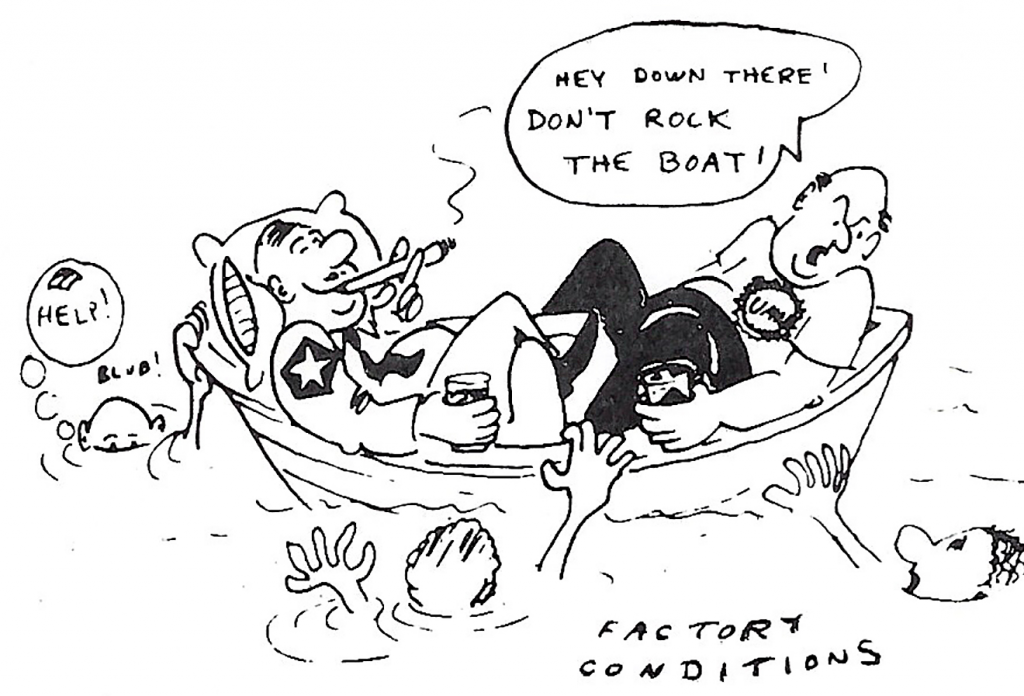
Everyone who worked in plants like that, or these days at Amazon and UPS, understood intuitively that the system was designed to drain every calorie of energy it could from you before releasing you to recover overnight. The highfalutin’ Marxist word “exploitation” is experienced more simply as getting squeezed or wrung dry. So every worker’s goal once they knew the score was to beat the system somehow.
My challenge was to find ways to beat the system collectively rather than individually. Most workers seek the personal way out, since it is the most obvious in their experience. Dog eat dog.
Fortunately, I had some ideas learned from conversations with Stan Weir, a longtime southern California labor organizer in the Independent Socialist League, who taught me to listen first, not preach.
Stan Weir was the model for the character Joe in Harvey Swados’ novel, Standing Fast. Stan took organizing literally: he saw the workplace as an organic structure, where the first molecule was the informal work group. These are the people you are in constant contact with, just in order to do your job.
For example, a door assembly line had about eight people directly on the line: guys like me who welded the parts together; one who “married” the inside of the door to the outside panel; an inspector who checked each piece as it went by on the conveyor belt; and several guys who loaded the finished doors into racks for forklifts to pick up and drive to waiting railcars.
Our group intersected directly or tangentially with other work groups, joining one molecule to another. We depended on the forklift drivers to bring parts and carry away assemblies, on material handlers to make the parts handy, on pipe fitters to keep the sound deadener gunk and rust prevention sprays working, and on tool makers to adjust the spot welding machines.
Offline, but within sight, were metal finishers and torch welders who repaired doors damaged in the course of assembly. Each of these tangential workers had their own informal work groups.
Stan told me that my first job was to listen to and understand the people in my informal work group, then to identify the natural leader in that group. Later I would find the leaders in other work groups and try to link them. The company organized people and groups according to their functions and linked them by foremen. Stan’s model was to see them instead as autonomous collectives linked by self-interest through their natural spokespeople. (See https://www.tempestmag.org/2022/06/a-new-era-of-labor-revolt-1966/)
Gaming the System
Many of the spot welders and press operators in our plant spontaneously found a collective way to beat the system. They did It by working harder than necessary to get the job done, then taking turns to stop working (“go on break”). If there were four loaders filling racks with finished doors, three would work at a time while the fourth took a quarter hour break, then came back and relieved the next guy.
Similarly, entire lines worked extra hard to “make production” each hour and go on break prior to the contractually agreed five-minute hourly break. Every operation had a break-even point for the hour, say 250 doors, and a production quota, say 300 doors.
Meters on the line watched with eagle eye by the foremen kept count. The extra 50 doors produced were profit. Even though it was obvious that those extra doors, our surplus value, owed nothing to anyone except we who made them, they were whisked away for company’s use any way it wished. We had zero say and Marxist economics stood naked in front of our eyeballs.(6)
Our spontaneous collective sought only to game the system rather than beat it. Management obviously knew what we were doing but went along with it because it served their interest as well: meeting their quotas.
All that changed after Japanese engineers came to America in the mid-’70s to study our system as Chrysler engineers proudly showed them through the plant. In reality the visitors were doing detailed time and motion measurements, then went home determined to eliminate all of American management’s missed opportunities to collect every calorie of workers’ energy.
Easy jobs, taking turns working, etc. were eliminated in Japan, their econocars wiping out Big Three models in the market. Detroit in turn by 1984 adopted Japanese methods, nicknamed “management by stress” by Mike Parker in his books. Auto work as a tolerable way of life disappeared.
But even before that transition, to beat the system we would have to be in a position to turn production on and off like a faucet. Instead of working harder to get a break, we would have to work slower to exert collective power and prioritize more distant goals over immediate work relief. We looked to the British shop stewards’ movement as a model for using workers’ control, but nobody came anywhere near to replicating that movement.
Plant Dynamics
Race and ethnic dynamics determined everything in the plant. Your race was determined by how some other group looked at you, usually based simply on skin color. Ethnic dynamics were independent variables.
Thus, Black workers cohered sometimes as church and neighborhood members, sometimes as street people. So did whites, family and neighborhood largely determining promotion to better jobs. Then there were self-contained European clusters, most evidently the Polish workers, some of whom could barely speak English after 20 years at Chrysler.
There were few women in the plant, so women’s issues beyond tokenism did not became political in the union hall or on the shop floor until Jane Slaughter (from the IS) hired in and started explaining blue collar feminism through the pages of the local union newspaper, where she rapidly became assistant editor.
When I arrived, union politics was defined into hard voting and service blocs. The misnamed Rank and File Slate was based in skilled trades and conspicuously racist. Skilled trades were the minority, so they depended on white production workers to control the union hall — President, VP, etc.
All were Administration Caucus (formed by Walter Reuther in the late 1940s) loyalists. In the plant, stewards and committeemen posts were controlled by the Black opposition to the Rank and File Slate. The opposition had a minority of support among white production workers. Their leaders were also total Administration Caucus loyalists.
Our strategy was to unite Black and white production workers around shop-floor issues, at the expense of the UAW brass and their sycophants, who had long since abandoned class conflict on the shop floor in favor of the “gold-plated sweatshop.” Our newsletters and flyers came to the defense of oppressed groups — Blacks or women — who were being abused.
Prior to being awarded “seniority” at 18 months, thus prior to leaflets and openly organized agitation, I joined and eventually chaired the local union Fair Employment Practices Committee. I could investigate discrimination grievances like a steward, though stewards never did.
During this period, since I also showed up at union meetings and spoke, the Rank and File Slate tried to recruit me, sending me to Black Lake, the UAW leadership resort, for training. Training amounted to following top-down leadership from the Administration Caucus and liking it.
Eventually militants had to move beyond contract proposals, shop-floor reporting, and good ideas, to contend for power in order to implement our program. Program meant not a set of declarations, but the general idea that the union was the workers. We should act for ourselves to get what we needed, not depend on the company or union bureaucrats who wanted to “represent” us as a lawyer would, shutting us up because they knew better what was good for us.(7)
Although various workers were supporters and sometimes spokespeople for our caucuses and slates, the two figureheads that defined our politics in everyone’s eyes were the tool crib attendant George Brooks and myself — one Black, one white, both independent of the existing power structure and brazen in our stances.
We re-divided the plant, replacing white vs. Black with rank and file workers vs. the company and its union handmaidens. We had slates of candidates for several union elections and convention delegations. George was elected steward and I wasn’t. In 1977, I was finally elected vice president, defeating the Rank and File Slate candidate by a solid margin, 1100 to 900, with support from the traditional Black slate. That was the beginning of the end of the Rank and File Slate and race-defined union politics at this factory.
A year later the traditional Black-led production slate won the local president spot and the traditional white-led slate started working with him. Their hope was to return to the careerist, class-collaboration union life they knew before. Racism no longer served them, so they ditched it in public. Their common enemy was us — the movement for class-struggle unionism.
Bailout and Purge
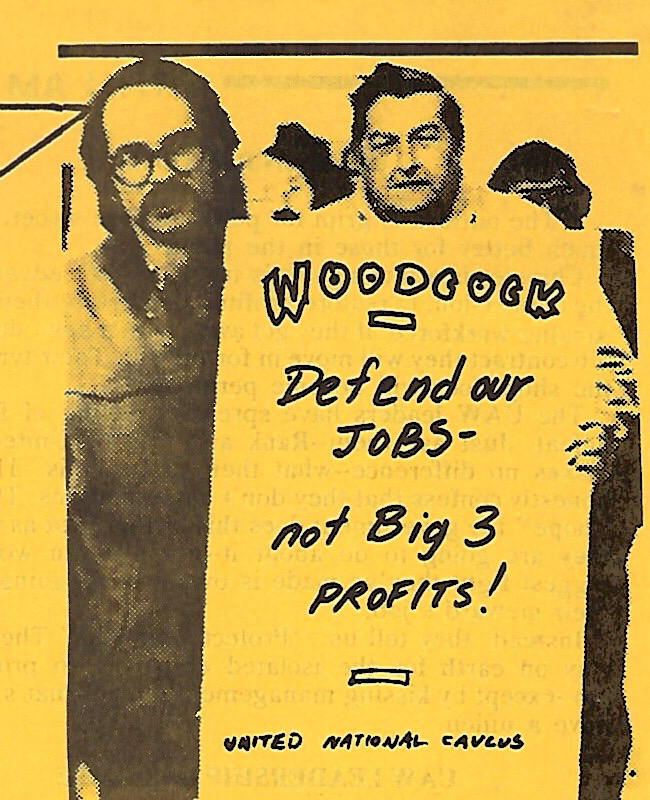
David McCullough (left) at 1975 March on Washington.
The watershed decision for class struggle vs. class collaboration came in the Spring of 1979. Should the UAW and federal government bail out Chrysler by workers accepting concessions in return for government loans to the company?
We argued that if Chrysler could not make a profit it should be nationalized under workers’ control. Workers had the skills and interest to convert it to the manufacture of useful products.
I had chosen not to run again for VP and lost in my attempt to become chairman of the shop committee, the real center of power as opposed to the union hall, so George was isolated after winning the committeeman slot for his division.
We had lost some leverage and the newly united Black and white local union leadership were unanimous in preaching that the workers “must learn to eat crow” to save the “goose that laid the golden eggs,” Chrysler.
To make sure they won the battle for concessions, the union and company collaborated to fire three IS activists in Spring 1979 — first Jane Slaughter, then Mike Parker, then me.
Jane was fingered to management by a UAW committeeman as a leader of a wildcat strike previously at Cadillac Assembly. My guess is that the committeeman relied on the UAW research department for that information. She had a week or so to go to achieve 18 months seniority, which would have protected her.
For Mike, they had to eliminate his job title and lay him off. For years afterward, the Warren Stamping Plant had to operate without an electronics specialist of its own as they avoided calling him back.
In my case, UAW Pres. Doug Fraser wrote me that the union would not win my grievance (discharge for refusing a direct order) if taken to arbitration, therefore it was withdrawing my grievance. This despite a ruling by an administrative law judge in the Michigan Employment Security Commission that I was fired without cause, “no direct order having been given and none refused,” following a formal hearing with lawyers and witnesses on both sides.
None of us won our jobs back. Organized class-struggle unionism faded away at Local 869 as some of our colleagues were co-opted as paid full-time union operatives. You could argue that I failed to build a caucus that could outlive my role in it, a democratic group rooted in its given level of collective consciousness and commitment. I prioritized forcing change in the system over spreading responsibility among our cohort.
The group was not prepared for the long defensive battle ahead. The offensive battle to win the UAW for class struggle unionism ran for eight years from 1971; the defensive battle that followed our defeat has lasted 40 years.
Building Connections Across Lines
IS autoworkers collaborated across local union, company and industry lines. The epicenter of our inter-union auto work was the United National Caucus, whose citadels were the GM Tech Center where skilled workers designed cars, and Ford Local 600, the Dearborn facility that made its own steel and most everything else for cars and trucks that rolled off its assembly lines.
The UNC had organized in opposition to the Reuther Caucus in the 1960s and was well-entrenched when we arrived in the early ’70s. UNC organized picket lines and press conferences at both GM headquarters and UAW Solidarity House. We went to regional and national conferences held every year and to regional picket lines.
One evergreen issue the UNC promoted was reducing work hours under the slogans “30 Hours Work for 40 Hours Pay” and “30 and Out.” These addressed cyclical layoffs/excessive overtime, early retirement and full employment.
When the Industrial Union Division of the AFL-CIO called a March on Washington for jobs in 1975, 60,000 showed up. IS had its own banner and contingent, although our autoworkers, steelworkers and teamsters marched with contingents led by reform movements in their own industries — the UNC in my case, Concerned Truckers for a Democratic Union, the CWA United Action Caucus, the Coalition of Labor Union Women (CLUW) and others.
All these and others cohered as the ad hoc Rank and File Coalition and included unemployed people as well. The coalition had its own section of the march from the Capitol building to RFK Stadium a couple of miles away and the UNC marched as part of the coalition. The marchers were a militant group, with signs like “Fuck Ford” as well as “30 for 40.”
By far the most fun part of that day was when we at the rear of the march reached the stadium and found that it only seated 40,000 and the gates were locked. The 20,000 workers locked out quickly tore down the fences and gates and flooded the field below the podium set up for union officials and Hubert Humphrey to give speeches.
When Humphrey tried to speak, he was drowned out by boos and chants from the crowd, most of whom were probably Vietnam vets. He had long lost any credibility and took down the rest of the speakers with him. The crowd broke up to march back, thinking it had done a good day’s work by rejecting political-bureaucratic BS.
After the march, IS held a public meeting near the Capitol aimed at the Rank and File Coalition marchers. They had marched side by side from different industries, but we wanted to create a chance for them to talk together, swap literature and contact information, and think of coordinating their militancy. IS had a table to entice those who wanted to go even further.
There were no national Black organizations to ally with the way we did with CLUW. By the mid-’70s the Panther Party had lost leadership of Black liberation struggles, with nothing to replace it on the street. That militancy had moved into the factories, where Black production workers were already in the lead of rank and file movements like DRUM. There was no separation of “identity” and class politics; the Black working class in Detroit already saw its class struggle as the road to Black liberation in the streets.
IS-led union caucuses went beyond the plant level to ally with progressive single-issue movements. Example: The Free Gary Tyler campaign started in 1974 on behalf of a Black youth framed for murder by Destrehan, Louisiana cops, reached into the plants — my local called for his freedom — and into the community.
The IS youth group Red Tide participated as well. I got a Red Tide militant invited to our local union meeting by the local leadership to make the pitch for freeing Gary Tyler. The local voted in favor. But Gary spent 40 years in Angola prison, several on death row. (Gary Tyler eventually won release on a plea deal. He visited in Detroit in Fall 2022 and met with some former IS members.)
Seeds of the Future
Throughout the 1970s the IS organized conferences and network connections between rank and file caucuses, linking different industries. These planted the seeds of what later become Labor Notes. The soil they grew in, however, was not what we had planned for.
We understood that the wave of labor militancy in the ’70s was not only an extension of ’60s anti-establishment visions of a better life and resistance to everything that made life worse — war, racism, sexism. We also understood the specific economic dynamic that drove our bosses to try make their lives easier by making ours worse: the falling rate of profit.
Kim Moody, Anwar Shaikh and others analyzed the end of the postwar boom in America around 1970. During the previous 25 years, labor’s share of surplus value in highly unionized sectors had kept pace with an annual 3% rise in productivity.
Following the 1930s Great Depression and World War II, there was persistent growing demand for automobiles that kicked the can of overcapitalization down the road. By 1970 the market was saturated with commodities in the advanced Western countries and no progress was in sight toward creating new markets in the third world or the Communist countries. Nor were big wars in sight as ways to reduce overcapitalization by blowing it up.
So the corporations were on the attack. Wages and benefits hadn’t been on the chopping block in the early ’70s. Periodic wage increases were part of the corporate business model as the price of labor peace, most particularly peace on the shop floor.
We called this status quo the “gold plated sweatshop” — the union did not challenge the company with direct action on the shop floor but the company, unable to cut wages and benefits, was free to extract more surplus value in two main ways: speedup and lengthening the work day.
Speedup and its culture of treating people as cogs in the machine had already led to years of Black-led rebellions. By the time the IS arrived in Detroit, working conditions, including company racism, became the initial focus of our militancy. By the mid-’70s compulsory overtime coupled with layoffs was added to the mix and the two together triggered a sustained fightback. So we were able to make the first steps toward organizing that fightback that the UAW leaders refused to lead.
But the soil was shifting under our feet and we did not realize it. The automakers, like the American steel industry before it, moved to sustain their rate of profit by switching to a new business model: a preemptive class war on employees’ wages and benefits.(8)
They stripped the gold plate off the sweatshop. Chrysler led the charge in cahoots with the UAW leadership, betting the farm that UAW members would take money out of their pockets and give it back to the company before they would fight to win. They were right (not that UAW members were ever asked.)
The IS ranks, along with many others in the class struggle union movement of the ‘70s, were not widely enough embedded or influential with the millions of workers at risk to head off concessions. We tried and we lost.(9)
A few years into the 1980s, concessions had spread across industry. Comrade Steve Kindred, an early organizer of TDU, said at a meeting in the early ’80s “We’re going to get our teeth kicked in for a few years.” I thought he was exaggerating. On the contrary.
Lessons for Today
Looking back, I think IS made the correct choice given the alternatives available. Committed to socialism, we picked the workplace as the arena and class struggle unionism as the tool to fight for it. We had a step-by-step roadmap to get there.
When that strategy crashed as militancy ceded to the false defensiveness of concessions, one part of the IS split off to focus on propaganda and concentration in universities and some white collar sectors, where the International Socialist Organization worked with some success for decades before dissolving.
Our own strategy became moot as the U.S. economy deindustrialized and the central industrial unions like auto and steel lost their strategic power. That vehicle to a labor party and anti-capitalist socialist combat for power choked and stalled and moved over to the slow lane.
One thing stayed the same: organizing on the job, from below. The International Socialists shifted their emphasis to linking rank and file organizers across the board. Labor Notes (launched in 1979) became the institutional form this took. It provided both theory and practice for the 40-year prolonged defensive movement, and at the same time cultivated organizational techniques for going on the offensive.
DSA labor committees today are trying to decide where to invest their energies. I think it makes more sense to organize among the people you spend a third of your working days with, rather than making cold calls door to door or hanging around the fringes of other people’s organizing efforts.
It makes more sense to institutionalize whatever gains we make by direct action than to pin our hopes on the General Strike. And finally, history and our own experiences have shown conclusively that it is not enough just to win electoral majorities in either government or unions.
The Marxist idea that the working class learns the ability to govern in the course of organizing itself to win power still applies. We can’t just take over the capitalist machine.
Today’s young workers and young socialists are discovering for themselves that the rank and file strategy is the way to go and that they don’t have to wait for somebody else — in particular the traditional unions laden with bureaucracy or, like the SEIU, organizing from the top down.
The range of allies we are looking at today has broadened to reach unorganized workers, dispersed workers, unemployed and home employed workers, pink collar workers, service workers, and the public at large, as teachers’ unions have discovered.
The Quiet Quitting movement, the critique developed in the book Bullshit Jobs and the like, have nurtured a shared realm of consciousness for manual and office and home workers: the job is not what’s most important in our lives. Giving your best to the job is no longer a path to a good life at home.
The requisites of a decent life have to be applied on the job as well as off the job — such as air-conditioned trucks for UPS workers in an overheated world, or regular sleep patterns for pilots and flight attendants. Workers’ demands, union demands and public demand, converge toward campaigns for human rights.
Health is a human right. So is life — including Medicare for All, guaranteed income, socialized child care, and canceling profit to save the environment.
-David McCullough, Atlanta DSA
Notes
- “Independent” was the key word for me in joining the socialist world. The ISC owed nothing to the safe havens many American 60s radicals posed as real world supports — Cuba, Maoism, the CPs and SPs, third-world liberation. We had to make our revolution ourselves, depending on nothing but each other.
back to text - DSA faces the same problem today. It wants to be for “all good things” like a political party but can’t commit to an area where it could be decisive.
back to text - See Kim Moody for an overall picture of industrialization. https://www.tempestmag.org/2022/07/origins-of-the-rank-and-file-strategy/?utm_source=rss&utm_medium=rss&utm_campaign=origins-of-the-rank-and-file-strategyback to text
- Key in their ability to shut down the economy of the day.
back to text - At ITT we carefully organized a sitdown strike and won in two hours.
back to text - Sometimes called “wage slavery.” I like Stephanie Coontz’ pithy comment on slavery: “Slave owners responded to the global market by combining the ruthlessly impersonal profit calculations of mass production with the cruel intimidation required to extract maximum effort on exhausting tasks while forestalling resistance by enslaved people, who vastly out outnumbered overseers and owners.” Stephanie Coontz, “American History is a Parade of Horrors — and Heroes,” Los Angeles Times Op-ed, August 14, 2022. Impersonal profit, maximum effort, thwarting resistance — life in auto factories.
back to text - In 1975 my literature in a run for local president included “30 for 40 to end unemployment; smashing racism at work, in the union and community; no support to Democrats, Republicans, Wallaceites, or Kennedy, but a labor party instead; fighting the boss at the point of production; nationalizing Chrysler if it can’t afford full employment….Equally important though were issues like the women’s restrooms and union finances….” p. 3, orkers’ Power, June 5-18, 1975.
back to text - The corresponding shift in capital strategy echoed steel captains’ failure to invest in plant in the ’60s and early ’70s to insure long run competitiveness. When questioned about this in Iron Age magazine in 1971, an industry boss famously replied “In the long run we’ll all be dead.” The big three automakers never invested to produce small, efficient cars. They have been saved from the dustbin only by SUVs and trucks.
back to text - This summary is analyzed in great detail in the closing chapters of the Rebel Rank and File: Labor Militancy and Revolt from Below During the Long 1970s, edited by Brenner, Brenner and Winslow. Verso, 2010.
back to text
January-February 2023, ATC 222
This article was originally published on Against the Current Feb. 2023
If you have questions about any of this, especially its relevance for today, please write me at dm10639@gmail.com.
The post A Radical’s Industrial Experience appeared first on Red Clay Comrade.
Off the tracks, Ohio and the environment
A toxic train derailment turned the focus of the world to the tiny town of East Palestine, Ohio. Tonight we'll talk to Timothea Deeter, an East Palestine resident and Mahoning Valley DSA member about how mutual aid can transcend political boundaries and what her community needs moving forward. We'll also zoom out and look at the larger environmental degradation of Ohio and neighboring states. We're joined live tonight by Andrew Woomer, the advocacy Coordinator for the Southwestern Pennsylvania office of the Clean Air Council. Andrew is from Pittsburgh and was in East Palestine earlier today dropping off air purifiers. We'll talk to him about that and his work to monitor and organize around petrochemical and oil and gas issues across Pennsylvania. We'll also hear from documentary filmmaker David Ruck about his film The Erie Situation on toxic algae blooms in Lake Erie.
Follow Mahoning Valley DSA on Twitter and Facebook
Watch the trailer for "The Erie Situation" and follow filmmaker David Ruck on Twitter
Follow Clean Air Council on Twitter and you can donate to their mutual aid efforts in East Palestine here