Capacity and Militancy
by AC
Our chapter is fortunate to be growing and maintaining a high percentage of active members. Folks have taken this to indicate our chapter can expand to take on additional work. In the past few months, I have been deeply skeptical of our ability to expand on our current work largely from my experience on the Trans Rights Priority Project leadership team and observing the trajectory of the Immigration Solidarity Priority Project first term. While our chapter’s growth has led many to believe we can expand our work, I’m increasingly convinced that growth in membership alone is not enough; without significant member engagement across the chapter, we risk projects that are doomed to fail and further burning out our most experienced organizers.
What finally put my nebulous feeling about our lack of capacity into perspective was my recent trip down to Louisville DSA to canvas for their electoral candidates. Louisville DSA is supporting four candidates for local- and state-level offices concurrently in a chapter virtually the same size as Cleveland DSA. They also have a Trans Safe Haven campaign similar to our Trans Rights Priority Project, which is pushing sanctuary city legislation. This project has the support of over 100 local unions and political organizations and has collected at least 3,000 signatures from residents in the two years it has been running. Louisville DSA also has several other active campaigns, a building fund with over $10,000 towards purchasing a permanent office, and several educational projects. Talking with Louisville comrades, I must be honest that my initial reaction was one of embarrassment that our chapter is struggling to succeed in a fraction of the work of our southern comrades. I feel there is a significant barrier in our way to accomplishing what Louisville DSA has, which is a lack of militant engagement across our membership.
Our work requires militancy; not in the sense of posturing or burnout, but in the sense of disciplined, collective commitment to carrying out democratically decided work. To be militant socialists, we must be dedicated and principled in our organizing. That means showing up to meetings on time and prepared, to be uncompromising in our pursuit for liberation of the working class. It also means taking responsibility and initiative to carry our democratically decided work forward – even when we might have our own personal reservations – and thinking critically and strategically about all projects as we design and deliberate on them. As a brand new member in late 2024, I sometimes took it for granted that every project the chapter took on would build power for the working class, even if only a little bit. At the time, that little bit was good enough for me and I was often frustrated when experienced comrades pushed me to articulate explicitly how certain work would build power for the chapter and/or the working class as a whole. Now, over a year in with some leadership and organizing experience under my belt, I can see more clearly how this is the critical question that should inform every action we do as DSA.
Newer members often have understandable hesitancy and insecurity about entering into political activism and organizing work, which is counterintuitive to the rugged individualism and liberalism under which we have been indoctrinated our entire lives. Experienced organizers must cultivate an environment of support and empowerment to overcome this capitalist indoctrination. Newer members must also be willing to challenge themselves and take the leap into the unknown. They will encounter failures and make many mistakes, but that is a critical and unavoidable part of the learning process.
Outside of DSA, I teach for a living. My own teaching philosophy, based on the science of teaching and learning, rests on a foundation of practice and feedback. Whether it is learning in a classroom or in a conference room, it makes no difference; personal growth and development are iterative processes. Few of us are thrilled by the notion that trial and error involves error, and many “baby leftists” are understandably risk averse – they want to avoid letting their comrades down or sounding dumb. In our current internet age, social media cancel culture and purity testing within the leftist spaces that radicalize so many of us also infect us with the fear that holds us back from meaningfully engaging. Still, this is what the role of a militant member of a collectively run organization asks from us. Sharing your opinion in a meeting can be nerve-wracking, but participation is both something every member is entitled to and something the organization desperately needs from its members.
When I talk about doing the work, I don’t just mean actions like canvassing for a petition, bottomlining an event, or organizing a new member. Doing the work is also voicing your opinion during a project meeting, commenting on proposal drafts, and speaking for or against proposals during the general meeting. All members in good standing are entitled to participate in all of these activities and are responsible for doing so. We cannot defer to the oldest, loudest voices in the room. It allows for personal biases and cliques to dominate the governance of the chapter, and it robs members of their own political development. Often in meetings I observe the same people dominating conversation, including myself. When I try to pull back and make space for others, often the void remains unfilled. I find this both personally frustrating and concerning with respect to the long-term health and viability of the chapter. Our work is one of collective, participatory democracy, after all.
I feel an aspect of militancy that is especially important to our chapter as of late is the act of showing up when it is inconvenient or hard to do, or when the project isn’t your personal favorite thing. No matter how much or how little someone has on their plate, organizing is hard work. It will take all of us and so many more to bring about the socialist future we dream of. Of course, there must be a balance between maintaining militancy and avoiding burnout. This balance is something I personally struggle with. I like to joke that I suffer “chronic volunteering disease” and often catch myself internally asking some version of “If not me, then who?” I know I’m not the only one who feels this way; in one of my all-time favorite books on organizing, Dean Spade describes what sounds an awfully lot like my own chronic volunteering disease:
“For years I had a pattern where whenever I was in a meeting and the group identified a task that needed to be done, I would feel a strong impulse to volunteer for the task. It stemmed from my unconscious desire to be seen as useful, and to secure my place in the group by being of service. It also often included a tinge of anxiety that the work either wouldn’t get done, or wouldn’t get done in what I thought was the ‘right’ way. This pattern sometimes resulted in overwork, exhaustion, and neglect of other parts of my life.”
Chronic volunteering disease contributes to unsustainable relationships with the movement that create the conditions that stoke resentment and organizer burnout. Objectively my brain knows this, and yet I continually return to “If not me, then who?” It isn’t a fully rhetorical question– someone really has to do the tasks of maintaining the movement, whether that is creating an agenda, writing a proposal, throwing a social, or showing up to canvas on a Sunday morning. As the Trans Rights Priority Project likes to say, “It’s YOUR project, it doesn’t work without YOU!”, where “you” is everyone in the chapter, from the most seasoned organizer to the comrade who signed up to pay dues yesterday.
One additional observation that informs my opinion is that many of our most experienced, long-term organizers are currently sitting on the “burnout bench”. This situation obviously arises from a variety of factors: some have other life obligations or obstacles, some are dealing with interpersonal conflicts, and some have a necessary and well-earned break after intense service to the chapter. In my discussions with Louisville DSA comrades, I wondered about whether they were able to carry out their large amount of work sustainably, and asked if each project was successful due to an unreasonable amount of work put in by senior organizers. There was a telling pause in the conversation, before the comrade acknowledged several of the projects were relying on several members pushing themselves to the brink of burnout – potentially a cautionary tale for us to consider as we grow here in Cleveland. It is expected that individuals’ capacity ebbs and flows throughout their tenure in the movement. Therefore, we have to ensure that our work continues when members need to take a step back. This requires other members to step up and support their comrades and the work of the movement.
Overall, I do have faith that our chapter can continue to build power for the Cleveland working class and should be able to grow the work we are engaged in, but only if we approach our current and future work with intention to build power, increased militancy, and care regarding membership capacity. My ask to the “oldheads” – practice pausing for others to speak and to intentionally ask newer comrades what their thoughts are. Be mindful about how you respond, especially if you disagree. Check in with yourself about your capacity. If you need to take a break, actually take it! It is difficult to feel restored when ruminating on chapter work, even if you aren’t actively showing up. But also, ask yourself about whether a situation calls for militancy. My ask to newer comrades – take a chance and challenge yourself to become comfortable with the inevitable mistakes that will and must happen. Seek out information from comrades you respect and trust (and some you might not yet!). Volunteer for a small task at a meeting. Connect back to the reasons you joined DSA in the first place – hopefully to become meaningfully engaged in the socialist movement!
The post Capacity and Militancy appeared first on Democratic Socialists of America.

Wrap this poem around a brick and throw it
Wrap this poem around a brick and throw it
through the boss’s window
not the window at the office the window
at the boss’s home
let the glass glimmer sharply let the shards
be swept through labor gone unpaid
wrap this poem
around a brick and throw it
in the river tied to the letters from the debt collector
not the letters that say your account is past due the letters
that say they will take what you owe right out
of your paycheck
let the river runoff
shimmer smartly let the silt
that churns and grinds osage orange seeds for want
of mammoth teeth shred the letters too let debt go
the way the mammoths went wrap this poem around
a brick and throw it on the pile
until there’s enough stacked for the landlord to charge rent
not the rent you pay to live
under a browning ceiling not the rent
you pay to listen to your favorite song not the rent that rises
steady as the temperature the seas the misery the people the rent
that says your home will never be yours
let the fury simmer darkly let the rage
loose in a poem wrap this poem around a brick
and throw it
Working-class historical marker removed from Market Square
A major historical marker of working-class history in Pittsburgh has disappeared from Market Square where it stood prominently since 2008.
The marker, titled “Work Accidents and the Law,” commemorates a research study and book under the same name completed by American Civil Liberties Union founder Crystal Eastman. One of 2,600 cast aluminum plaques around the state, the marker was removed when Market Square was torn up for renovation in 2025. The renovation was spearheaded by the Pittsburgh Downtown Partnership and guided by strategic plans from the Partnership as well as the Governor’s office and the City of Pittsburgh. The renovation was completed and unveiled on April 22 in time for the NFL Draft, but the marker was no longer there.
Several local residents who care deeply about the marker and its historical significance to the working class in Pittsburgh noticed the marker was missing and started to ask questions.
Charlie McCollester, a local labor historian who wrote the description for the plaque and submitted the request for its content and location in 2008, said he was particularly concerned after noticing the marker was missing in April. He wrote a letter to Mayor Corey O’Connor expressing concern over the marker’s removal and requesting that it be returned to Market Square. He hand delivered this letter, along with a copy of his book “The Point of Pittsburgh,” to the mayor’s office, but never heard back. Calder Buisch, a local labor lawyer and member of the Democratic Socialists of America, also noticed that the marker was missing and brought it to the attention of Steel City Socialist.
Steel City Socialist was able to confirm with the mayor’s office that it was removed during construction and placed in a Pittsburgh Department of Public Works warehouse. The mayor’s office said that they plan to move the marker to a different location and have reached out to the Pennsylvania Laborers’ District Council to help them decide where to relocate it.
Historical markers in Pennsylvania are managed by the Pennsylvania Historical and Museum Commission and their locations are decided by the commission and residents who petition to have the marker erected. The commission’s Historical Marker Policy says: “If a property owner on which an Historical Marker is located requests its removal, Commission staff may remove it and reinstall it at another location.” The owner of Market Square, where the marker was located, is the City of Pittsburgh. The Commission told Steel City Socialist that they are working with the Pittsburgh City Planning Department on the planning and preparation for the marker to be reinstalled this year, but did not specify where.
The marker’s historical importance centers around perhaps the most extensive and groundbreaking worker health and safety study in the country, which documented 526 workplace deaths in Pittsburgh factories in just one year. The study was completed by Crystal Eastman as part of the Pittsburgh Survey and took place from 1906-1907. This research led to our current workers’ compensation law.
After publishing her book, Eastman drafted the first workers’ compensation law in the country. In addition to co-founding the ACLU, Eastman was also a feminist, an anti-World War I activist in Europe and the editor of a socialist newspaper during the first Red Scare. Buisch considers her a “model of who we should all want to be as socialists and as members of a community.”
When it stood, the marker helped present the workers’ side of history to Pittsburghers and tourists alike.
“The reality of the steel industry is that it was truly the worst of the worst of capitalist excess in the United States, where people were dying,” Buisch said. “People were getting permanently disabled, and then having their family starve to death, because they couldn't work anymore in the industry.”
Buisch first noticed the marker by accident due to its prominent and central location in a walkable downtown Pittsburgh area. It was on his route to work and his eyes were primed for it after he learned about Crystal Eastman at the Heinz History Center. The Pittsburgh Downtown Partnership and O’Connor’s office both declined to comment on the decision to relocate the marker instead of replacing it to its original location. The mayor’s office has stated it is working to relocate it with an unspecified timeline.
McCollester and Buisch said it should stay in Market Square, as it was put there by the Pennsylvania Historical and Museum Commission for a reason. Formerly located in a pedestrian park, the marker allowed both tourists and locals to stumble across its history easily, and it is located near the United Steelworkers building. The square is also the longtime site of an annual Workers Memorial Day observance, which commemorates workers killed or injured by their work.
McCollester said that no one was able to find where exactly Crystal Eastman lived in Pittsburgh, so it could really go anywhere — but the high exposure and proximity to the United Steelworkers building and Workers Memorial Day make Market Square a good location.
“It's very frustrating that I think one of the few places where people would be exposed to Crystal Eastman and exposed to the history of class and capitalism in America is getting taken away or moved out of a place where people actually would see it. It feels like it's gonna be covered up and tucked away,” Buisch said.
Socialists pack County Council to denounce ICE
In the first major test for its new ICE Out campaign, Pittsburgh DSA members turned out in droves at the March 10 Allegheny County Council meeting to demand the county cease cooperating with Immigration and Customs Enforcement (ICE). The meeting, which followed weeks of coordinated advocacy from DSA and allied organizations, ended in success: The council voted 11-3 in favor of an ordinance introduced by Councilmember Bethany Hallam that would restrict county officials from most forms of cooperation with ICE.
Socialists lead the charge
Most striking was the huge number of DSA members who turned out to speak. DSA was by far the largest presence at the meeting, with 15 members giving public comment – no other organization had multiple self-identified members speak. Graduate student-worker union members testified to the fear gripping their international student colleagues; neighbors pointed out the impact family separation and deportations have for the local public school community; and several members simply shared personal stories highlighting the humanity of their immigrant neighbors and the basic ethical obligation facing the council.
The chapter reaped the benefit of its huge turnout because it came in prepared to meet the moment. Previously, at its February general meeting, the chapter adopted the ICE Out priority, committing itself to joining and building the mass movement against Donald Trump’s terror squads. The timing could not have been more fortuitous: at a key political moment in the area, the chapter was able to mobilize its rank and file and become a hegemonic player in the action.
Strong organizing gets the goods
How did this come about? Looking underneath the proverbial hood of the organizing can give us a clue.
Pittsburgh DSA, like the organization as a whole, has experienced significant growth this year. From March 2025 to March 2026, the chapter grew from 574 to 849 members, a 48 percent increase. Motivated by the genocide in Gaza, ICE terror and DSA member Zohran Mamdani’s election as New York City mayor, new members have streamed into the chapter to get involved and make a difference politically. While this is an incredible development, chapter leaders have also been forced to grapple with how to activate these new members.
The answer lies in creating a structured space for members to organize and develop their skills. People typically join DSA because they want to do something to fight for socialism. The challenge of the activist core is to facilitate members’ meaningful participation – or to put it simply, give them space to do something. This is a lot more work than it sounds. Sometimes leaders can get frustrated and think the chapter is too low on capacity to take on work. But putting in more work at the beginning will pay off later. Leaders should always go back to two key questions: 1) What am I asking members to do? 2) Am I giving them the tools to do it?
The ICE Out organizers created that space for member action. It started with giving people tools to act. Leaders split up the work. One member drafted talking points, to give people a base of knowledge of how to speak persuasively on the issue. Others set up digital communications for email and social media to get the message out. For a rank-and-file member, the asks were clear: Talk to your council member. Show up to the meeting. Speak at the meeting. And tell as many people you can to do the same thing.
What took the action to the next level was individual member contact, or asking people individually to do things. Organizers called members personally and recruited them to speak. They specifically targeted new members with their outreach – many of the members who showed up had never given public comment or taken any action with DSA before. After a member volunteered, leaders followed up to make sure they had the tools they needed to participate. On the day of the meeting, organizers were on site to coordinate and personally welcome members.
Looking forward
The success of the County Council speak-out can serve as a model for the chapter’s work going forward. When given the chance and tools to take meaningful action, members do it. Over time, the activist core can bring those members “under the hood” to take on planning tasks. Rinse and repeat, and a healthy organizing cycle appears. When problems come up, leaders should go back to those core questions and fine tune their asks.
The meeting also highlighted how strongly DSA could assert itself in local politics. Its large membership numbers and sharp political approach give it the ability to turn out to city and council meetings in larger numbers than possibly any other political organization. The chapter has already taken a huge positive step by coordinating more closely with its one city councilor, Deb Gross. One path members should explore is Portland DSA’s model – its red shirts and signature logo have become a fixture at City Council meetings, with members showing up en masse to back their endorsed electeds in pushing a working-class agenda. This has created a virtuous cycle of raising the profile of socialist politics in the city while also helping pass policy that empowers workers and tenants.
In this reactionary political moment, Pittsburgh DSA has continued to grow in membership numbers and organizing acumen. With neighbors furious over anti-immigrant attacks and new members streaming into the socialist movement, DSA can seize the moment and be the lodestar of the battle for democracy. Adelante!
In Pittsburgh, work could be owned differently
In the U.S., we're taught the only ways things get done are through private business or the government. For many, these options are deeply disappointing. But there is an underexamined alternative: worker-owned and community-owned cooperatives. When I ask fellow Pittsburghers what they know about co-ops, most think of the consumer grocery model, which had a resurgence in the 1960s and 70s, like the East End Food Co-op. But the cooperative movement, particularly here in Pittsburgh, has a far longer and more diverse history than most of us were taught.
Some of the earliest U.S. cooperatives date to the 1700s. The Underground Railroad is considered to be an early example, as it was governed by the member-conductors who ferried people, many through Pittsburgh, to freedom.
In 1819, workers formed a producer cooperative, the Pittsburgh Manufacturing Association, collectively buying and running a warehouse where artisan and cottage industry workers could produce and consign their products for sale or barter. Goods produced and sold by cooperative members included farm produce, butter, cheese, wool, whiskey, soap, cloth, nails, plows, furniture, and roughly 60 other items.
In 1847, the first mass-production worker-cooperative factory in Pittsburgh was opened by a group of iron molders. In the following years, their success led to cooperatives of glassblowers, silver-platers, puddlers, and boilers. These workers even started a cooperative newspaper called The Pittsburgh Unionist.
Union and cooperative development accelerates in waves tied to economic, social, and political upheavals such as during the Civil War era into the Gilded Age. In 1867, the International Molders Union organized a chain of more than 14 cooperative foundries in major cities, including Pittsburgh. These workers hoped cooperatives would replace the need for strikes, which was how workers won union recognition and bargaining prior to 1935. Workers hoped this was a permanent solution to fighting private employers over low wages and bad working conditions.
The International Molders model went under due to economic and other challenges of the Gilded Age. But in 1877, a general strike of workers took charge of Pittsburgh and organized their own survival programs for five days until the federal government sent troops in to regain control. The Pittsburgh Commune, as it was called, occurred four years after the historically more well-known Paris Commune of 1871, giving new meaning to the phrase "Pittsburgh, the Paris of Appalachia."
This grew into the efforts of the Knights of Labor (KOL), who organized at least sixteen worker cooperatives in the Pittsburgh region, part of a larger network of roughly 200 worker-owned cooperatives KOL organized by 1886. Unfortunately, the KOL and its cooperatives fell victim to a nationwide red scare after a bomb went off at a union rally in Chicago, commonly known as the Haymarket Affair.
Another significant era of cooperative growth in the U.S. was the Great Depression. When privately owned electric companies refused to run power lines to rural areas because it wasn't profitable, people organized to build cooperatives to share costs and increase access. Electric co-ops still cover roughly 56–75% of the total U.S. landmass today, primarily in rural and suburban areas.
Researchers and practitioners like Jessica Gordon Nembhard, whose book Collective Courage is essential reading, believe we’re entering a fourth wave of cooperative development, particularly since the pandemic. The number of people seeking to form worker cooperatives has risen significantly, alongside a surge in union activity. The cost of living is climbing. Political and environmental instability is accelerating. Neither government nor private enterprise are equipped for these crises. Bringing true democratic principles into decision-making and economic distribution, cooperatives can empower people to solve their own problems and build their future collectively.
Consolidation of ownership into ever fewer private hands is making life worse for the rest of us. Notable examples include media mergers, such as Paramount Skydance and Warner Bros Discovery, which now control nearly half of the top 50 most-subscribed-to paid-TV channels. This consolidation means fewer, worse choices in media, reflecting narrower interests, lower wages, and job loss for workers, while companies continue to inflate prices.
We aren't taught the ways that work and control of resources could be done differently. This omission is not accidental; it reflects the owning class whose interests our economic education has served. But the cooperative tradition is long, global, and very much alive.
Cooperatives are on every continent, in over 100 countries. Nearly 3 billion people are made economically secure by cooperatives, with more than 12% of humanity participating in the 3 million cooperatives operating worldwide. Like unions, cooperatives are people-centered enterprises which emerge in response to economic discrimination and market failure. Cooperatives are collectively owned by the people who use them, not by whoever buys the most shares. Research consistently demonstrates worker cooperatives deliver economic and social advantages: enhanced workplace stability, increased productivity, greater resilience during downturns, higher wages, profit-sharing, and better benefits than comparable private businesses. Crucially, cooperatives extend their impact beyond membership to broader community development, providing essential services while anchoring jobs locally.
I've been a labor and community organizer for 14 years and seen workers fight for and win remarkable victories by building collective power in their workplaces and communities, particularly here in Pittsburgh. For example, Pitt Faculty Union workers, through organizing, won big raises, particularly for the lowest-paid faculty. Many salaries nearly doubled when the salary floor was raised to $60,000 in their first contract, not to mention the job security measures that were secured. This contract win is inspiring, but the current labor paradigm of contract bargaining back and forth isn't currently enough to provide for the majority of people or the planet.
Pittsburgh is already part of the resurgent worker cooperative movement. Third Space Bakery in Bloomfield, Greenhouse Co-op in Greenfield, and Pin-Up Posters Courier Collective are worker-owned enterprises taking root here. Keystone Development Center helps develop new cooperatives in Pittsburgh and the Mid-Atlantic region. The Pittsburgh Chamber of Cooperatives provides resources for worker-owned and member-owned businesses in southwestern Pennsylvania.
Pittsburgh Alliance for People-Empowered Reporting (PAPER), a group of Newspaper Guild of Pittsburgh journalists and supporters, gathered after the Post-Gazette announced its May 3 closure, which was later avoided by a sale to a new owner, the Venetoulis Institute for Local Journalism. PAPER, in light of massive layoffs under the Gazette’s new ownership, is continuing to host a series of town halls to find community support for a worker-community-run newspaper model. I’m planning to support them and encourage others in the community to join in exploring these models.
FOR MANUEL
A lifetime ago, in early 21st-century Seattle, my then partner and I began working at our favorite restaurant.
We were beloved by the family that owned it and well-liked by the Sikh cooks. It was far from the worst job I ever had. We waited tables there, enjoying a delicious free Indian meal with every shift. The kitchen’s ventilation system worked terribly, so eye-burning smoke from the tandoor oven often filled not only the restaurant, but much of the kitschy Wallingford mini-mall in which the restaurant resided.
My partner and I were particularly close to the middle-aged Salvadoran dishwasher Manuel. Both Manuel and the cooks worked from before opening till close.
Manuel tried to teach me Spanish, but I was a poor student. My partner translated what I couldn't understand, and between that and body language, he and I understood each other fairly well.
One day, Manuel walked up to me and gestured to my hands. He then raised his own hands. They were horrendously misshapen, swollen, and rough beyond words; transfigured from decades of hard labor. The knuckles were like large lugnuts, the fingers stretched too far inwardly, and his nails looked like they were drawn on by smeared marker. They barely looked human. I felt guilty for not having noticed before.
Several months later, Manuel asked the owner and chef if he could get one day off a week. It made sense, even the three cooks got one day off a week, reducing their hours by 10 or 11 hours weekly.
Manuel was quickly fired after that request. I guess the owner felt he had no use for a dishwasher who didn't work 7 days a week. He was quickly replaced by a young Latino man. Manuel came back the next week with a translator to ask for his job back, but the owner refused to talk to him.
When I think about why I'm passionate about socialism, it's for Manuel, and how our predatory civilization completely failed him.
It's for the planet.
It's for all of us.
Manuel, I hope you're doing ok, buddy.
Chapter Notes: June 2026
Hey hey, comrade! It’s another edition of the Pinellas DSA Chapter Notes!
We scored some very exciting victories this month (more on those in a minute). And, the socialist movement in Florida continues to grow at a rapid pace. But, as Antonio Gramsci said writing from a jail cell in 1930s Europe, “The old world is dying, and the new world struggles to be born: now is the time of monsters.”
The fascists sitting in Washington — and in Tallahassee — are feeling their grip on power slip. They’re desperate to hold on, and they’re more than willing to do what liberals, until very recently, assumed simply couldn’t happen here. The only way we can beat them and build a world in which all of humanity can thrive together is with mass, working class organization!
Every move we make is made with the aim of getting us closer to that goal, so read on and see what we’ve accomplished so far…and what comes next!
May Highlights

We started the month by joining in with other local progressive groups and labor unions to rally in downtown St. Pete in recognition of International Workers’ Day on May 1st.
We also hosted a fundraiser for Oliver Larkin, a member of Broward DSA who is running to represent Florida’s 25th Congressional District in Washington. Oliver’s opponent is a devoted zionist and self-described “DeSantis Democrat,” so we were happy to lend Oliver our support and endorse his campaign!
We rallied in front of the Florida Second District Court of Appeal building in downtown St. Pete in response to DeSantis’ illegal attempt to gerrymander the state and further suppress the voices of working Floridians. Members of our International Solidarity Working Group hosted a screening of The Voice of Hind Rajab, a powerful new film centered on the murder of five-year old Hind Rajab, as well as her family and the medics that attempted to rescue her, at the hands of the IDF in 2024. And, our Ecosocialist Working Group hosted a community town hall as part of our chapter’s ongoing Dump Duke campaign.
Anything we’re missing? Oh right…can’t forget the biggest news of the month! Pinellas DSA member Richie Floyd has been re-elected to St. Pete City Council! Months of knocking doors and collecting petition signatures by our campaign cadre paid off, ensuring that the socialist movement will continue to have a voice in local government for the next four years.
CAMPAIGN UPDATE: Re-Elect Richie Floyd
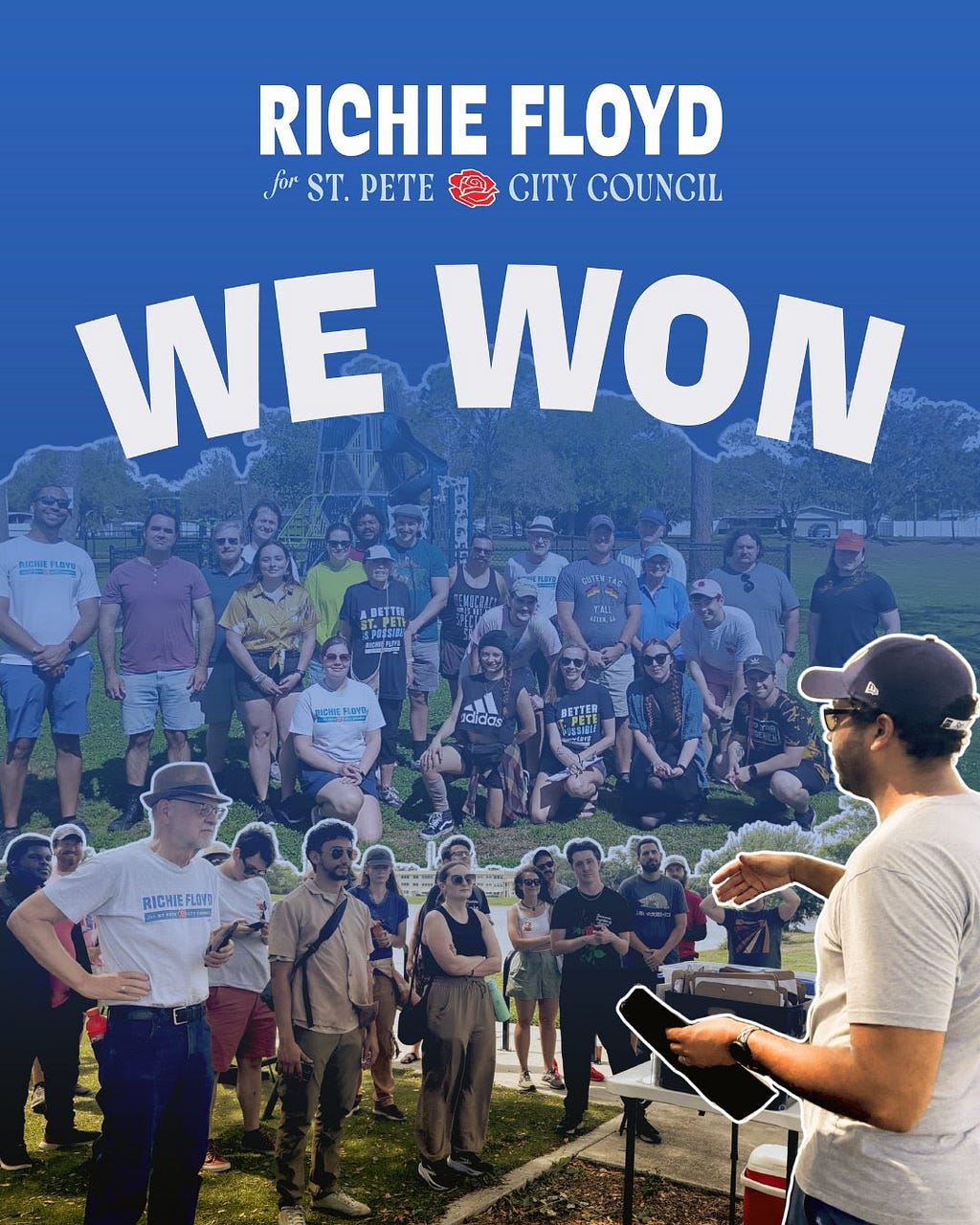
The campaign to re-elect PDSA comrade Richie Floyd to the District 8 seat of St. Pete City Council is complete!
As we did for Richie’s first election back in 2021, Pinellas DSA members pounded the pavement, collecting the 500 signed petitions needed for Richie to qualify for a place on the ballot. Noon on May 29th marked the deadline to register as a candidate for the August election, and with Richie as the only registered candidate, he is now officially running unopposed!
Everyone who was with us on election night in 2021 will remember what a nailbiter that evening was. But, this is the power of sustained grassroots organizing in action. When the capitalist class knows that the working class is engaged, activated, and ready to go to bat for the politicians that represent their interests…the capitalist class doesn’t even bother to show up.
HUGE congrats to Richie, the campaign team, and everyone in our chapter who knocked doors, sent texts, and raised funds to help make our victory happen!
CAMPAIGN UPDATE: Dump Duke
Our Dump Duke campaign is continuing to gain traction. In May, we hosted a town hall with St. Pete City Councilmember Richie Floyd titled Electric Bills 101. The aim of this presentation was to help St. Pete residents get informed, understand their bill, and learn how local decisions could impact costs in the future.
We also achieved a major milestone: getting St. Pete City Council to set a date and time for a vote on whether to commission a feasibility study for a public power utility. This study would be the first major step toward our ultimate goal of dumping Duke Energy and returning St. Pete’s power grid back to the democratic control of the people!
UPDATE: WE WON!!
We called for “all hands on deck” at City Hall on Thursday, June 4, and the people answered! Thanks to overwhelming pressure from the public, who took time out of their day to show up to tell their councilmember: Commission the study! Give us the facts on public power! the city council voted to commission the study, bringing us one step closers to our goal of Dumping Duke Energy!
To see what’s next for the campaign, go to dumpdukefl.com.
Upcoming Events
We have more than a dozen political events, working group meetings, and social outings scheduled in May. You can always view our full calendar of upcoming events, along with the most up-to-date times and locations, on our website: https://www.pinellasdsa.org/home.
Queer Movie Night with Queer Expression
Saturday, June 6 from 1:00–3:30pm at The Nest (544 1st Ave N. in St. Pete.). The Pinellas DSA Health Justice Working Group and Queer Expression are hosting Queer Movie Night where we will be screening Patient No More (2019). Pizza and refreshments will be provided!
“War on Cuba” Screening & Fundraiser
Sunday, June 7 from 6:00–8:30pm at Bar Chica (1180 Central Ave in St. Pete). $10 suggested donation to help buy medical supplies for the Cuban people.
Ecosocialist Working Group Meeting
Monday, June 8 from 6:30–8:00pm. Zoom only.
City Council Mobilization: Make The Morgan City-Owned Public Housing
Tuesday, June 9 from 5:00–6:00pm at St. Pete City Hall (175 5th St N. in St. Pete). Speak at St. Pete City Council during Open Forum to urge the city to buy The Morgan Apartments and make it into a model for city-owned public housing.
Portland Canvass
Tuesday, June 9 from 6:00–7:00pm at The Portland Apartments (300 8th St N. in St. Pete). Canvass to inform and encourage tenants to attend a tenants meeting, where they can tackle the issues facing their property together!
International Solidarity Working Group Meeting
Wednesday, June 10 from 6:30–7:30pm. Zoom only meeting; link will be available in Discord.
People’s Pride Coalition Teach-In
Thursday, June 11 from 7:00–8:30pm at The Nest (544 1st Ave N. in St. Pete.).
Morgan Canvass
Saturday, June 13 from 1:00–2:30pm. Meet at Family Pak and Ship (2822 54th Ave S. in St. Pete) to canvass The Morgan Apartments to encourage tenants to collectively withhold rent until slum-like conditions improve!
General Meeting & Socialist Social Hour
Sunday, June 14 from 2:00–4:00pm at Allendale United Methodist Church (3803 Haines Rd N. in St. Pete).
Steering Committee Meeting
Sunday, June 14 from 7:00–8:30pm. Zoom link.
Electoral Committee Meeting
Monday, June 15 from 6:30–7:30pm at Allendale United Methodist Church (3803 Haines Rd N. in St. Pete). Meeting in the Hybrid Room.
Housing Working Group Meeting
Thursday, June 18 from 7:00–8:30pm at Allendale United Methodist Church (3803 Haines Rd N. in St. Pete). Meeting of the Pinellas DSA Housing Working Group and St. Pete Tenants Union to decide action on tackling the exploitative capitalist housing system.
International Solidarity Working Group Meeting
Monday, June 22 from 6:30–7:30pm. Zoom only meeting; link will be available in Discord.
Educational-Social Working Group Meeting
Tuesday, June 23 from 6:30–7:30pm at Allendale United Methodist Church (3803 Haines Rd N. in St. Pete). Meeting in the Hybrid Room.
Socialist in Office Working Group Meeting
Wednesday, June 24 from 6:30–8:00pm. Zoom only meeting; link will be available in Discord.
Labor Committee Meeting
Thursday, June 25 from 6:30–7:30pm at Allendale United Methodist Church (3803 Haines Rd N. in St. Pete). Meeting in the Wesley Room.
Peoples Pride Coalition
Friday, June 26 from 5:00–11:00pm at Allendale United Methodist Church (3803 Haines Rd N. in St. Pete).
Pride Tabling
Sunday, June 28 from 7:30am — 5:00pm. We’ll be tabling on Central — check the Discord to get the cross streets!
Steering Committee Meeting
Sunday, June 28 from 7:00–8:30pm. Zoom link.
–
NOTE: All dates and times are subject to change, so check the website regularly for updates!

My Beef with RFK Jr.: The Problem with the New USDA Dietary Guidelines and Who Really Benefits
by Anna V.
Meat is expensive. It always has been. Prices are higher, sure, but it’s never really been cheap. Many people don’t think of it as the most expensive item but ounce for ounce it is. It’s why when you go to a hotel breakfast buffet the meat will generally be placed at the very end so you fill your plate with the less expensive fruit and bagels and can’t get as much of the pricier sausage and bacon.
The reason meat costs so much is due to the amount of resources needed to produce it. Before you can slaughter a cow you need to give it feed made from corn and soybeans for one to two years. Grass fed beef is even more expensive as it takes longer to get a cow up to slaughter weight on grass alone. This is why multiple studies have found that vegetarian diets can be less expensive, because instead of feeding soy beans to a cow for a year or more you can just make them into tofu.
That’s why it is concerning that the new USDA Dietary Guidelines for Americans increase the protein recommendations and are emphasizing eating beef – as well as the similarly expensive dairy – to meet those new recommendations.

It would be one thing if these changes were backed by science, but most nutrition experts heavily disagree with these guidelines. The Academy of Nutrition and Dietetics released a statement expressing concerns over the new recommendations (source). Furthermore, the guidelines actually contradict themselves. For example, they keep the recommendation from the previous guidelines to keep saturated fats consumption under 10% of total calorie consumption. However, in the list of recommended cooking fats are “beef tallow, butter, and olive oil,” two of which are saturated fats. Not only would canola and soybean oil be healthier, but they are less expensive, so it seems the new guidelines are going out of their way to make Americans spend more money on worse health.
Now it would be easy to write this off and say, “Well, everyone knows RFK Jr is crazy, no one is going to listen to him.” However these guidelines aren’t just suggestions for the average American. They instruct how federal food programs like WIC and School Lunches are set up. So if the guidelines aren’t making Americans healthier and aren’t reducing costs, who do they benefit? Well luckily they tell us on page 2: “We are realigning our food system to support American farmers, ranchers, and companies who grow and produce real food . . .”
A lot of people think of farmers as working class but don’t let the big trucks and boots fool you. A lot of farms are owned by large companies or families with generational wealth who make their profit exploiting the low paid farm workers who are the ones actually getting their hands dirty. These profits translate into power via groups like the National Cattlemen’s Beef Association and the Global Dairy Platform who go on to influence politics.
This problem isn’t even unique to the current administration. Probably for as long as you can remember you’ve seen the recommendation that adults need three servings of dairy a day. This has been heavily contested over the years. It’s not that you can’t have a balanced diet with that much dairy in a day, it’s just that it isn’t always necessary. Many people, especially those of non-European backgrounds, get all their nutrients in with little to no dairy. However, it’s in the guidelines and therefore has an effect on government programs. I once spoke to someone who had been on WIC and complained that they gave her way more milk and cheese than she knew what to do with.
So it seems these new Dietary Guidelines are continuing the theme of taking existing problems in our government and cranking them up to 11. The exact effects on programs like WIC haven’t been seen yet but they’re not likely to help struggling families. However, these guidelines aren’t meant to help them. They are meant to help the wealthy cattle ranchers who will destroy our environment, government, and health if it means increasing their own wealth.
The post My Beef with RFK Jr.: The Problem with the New USDA Dietary Guidelines and Who Really Benefits appeared first on Democratic Socialists of America.