The Morning After Is Already Here
There is a pattern to American politics. A right-wing government runs itself into the ground. The public turns against it. And before working people can build an alternative, the center moves in with a simple offer: just give us the keys back and we will restore order. The window between those two moments is the one that matters. It is open right now.
The Collapse Is Real
Trump’s second term has been a case study in the distance between populist rhetoric and plutocratic governance. The United States added only 181,000 jobs in all of 2025—the fewest in a non-recession year since 2003—while tariffs raised costs for the average household by $3,800 per year1,2. The Supreme Court struck down his tariff regime 6 to 3 in February 20263. The Congressional Budget Office found the One Big Beautiful Bill takes $1,200 annually from the bottom ten percent while giving $13,600 to the top ten percent and throws 11.8 million people off Medicaid4. Trump had promised not to touch Social Security or Medicaid5. DOGE then moved to cut roughly 7,000 SSA positions and targeted 80,000 VA cuts6.
The electoral signals are clear. Democrats swept Virginia’s statewide offices by as much as 15 points7. In North Carolina’s March 3rd primaries, three Democratic incumbents who voted to override Governor Stein’s vetoes were ousted by progressive challengers; Nasif Majeed, who voted for legislation defining sex in biological terms, lost 69 to 27 percent8. MAGA is collapsing. But that is exactly when the danger begins.
The Familiar Playbook
After Watergate, Democrats ran Jimmy Carter as a reform outsider. He deregulated banks and airlines, appointed the Fed chair who deliberately induced a recession, and abandoned labor. AFL-CIO president George Meany called him a conservative9. After 2008, Obama staffed his economic team with Wall Street insiders. His mortgage relief program promised 3 to 4 million modifications and delivered roughly one million while nine million families lost their homes10,11. Not a single senior bank executive was prosecuted12. Ninety-five percent of income gains from 2009 to 2012 went to the top one percent13.
Democratic centrists represent a coalition whose interests are served by managed capitalism with better optics. They are against us not because they are evil, but because we want different things.
The Lineup for 2028
Gavin Newsom governs California with the nation’s highest state unemployment rate and an $18 to $35 billion deficit he refuses to address with taxes on the wealthy1,14—while criminalizing homelessness and having done podcasts with Charlie Kirk and Steve Bannon to signal cross-aisle credibility. Buttigieg offers vague appeals to AI disruption. Next American Era, launched in February 2026, is led by a former congresswoman now lobbying for OpenAI and Oracle15. Third Way is running conferences aimed at opposing Alexandria Ocasio-Cortez16. This is not a left flank preparing to govern for working people. This is the party establishment clearing the field.
What Northeast Tennessee Tells Us
The material stakes are impossible to ignore here. Median household income in the Tri-Cities runs 70 cents on the national dollar, with poverty rates exceeding 20 percent in Johnson City and Kingsport17. Ballad Health failed 74 to 80 percent of its state quality benchmarks for four consecutive years while CEO compensation nearly doubled to $4.3 million18. Food insecurity has hit 16.8 percent—the highest in 20 years19. These conditions predate Trump. The “return to normal” centrist Democrats are selling is a return to the conditions that produced all of this.
The Fight to Name the Problem
Two stories are being told about why working-class life is so hard. The right blames immigrants and cultural elites—a false answer that connects to a real feeling of abandonment. The centrist story calls for competent management without naming corporate power, landlords, or hospital monopolies. The socialist story names the cause: wages are low because unions were broken; healthcare is unaffordable because it is a profit center; hospitals close in rural communities because there is no money in keeping poor people alive. These are not mysteries. They are decisions, made by people who profit from them.
The Window and What to Do With It
DSA has surpassed 100,000 members20. May Day 2025 brought hundreds of thousands into the streets in more than 1,000 towns21. The 2025 convention voted to work toward an independent mass socialist party22. A general strike on May Day 2028, backed by UAW and the Chicago Teachers Union, is being built now23.
Fascism is not defeated in blue cities. It is defeated where it lives—in the communities it recruits from, in the economic despair it feeds on. A new moderate will not fix the Ballad Health monopoly. A return to normalcy will not reverse 50 years of wage decline. The window is open. What we do with it will shape working-class life for a generation.
References:
- Bureau of Labor Statistics. (2026, February 11). Employment situation summary: January 2026. U.S. Department of Labor. https://www.dol.gov/newsroom/economicdata/empsit_02112026.pdf
- Yale Budget Lab. (2025). The tariff impact on U.S. households. Yale University. https://budgetlab.yale.edu
- Learning Resources, Inc. v. Trump, 607 U.S. ___ (2026).
- Congressional Budget Office. (2025). Estimated budgetary effects of the One Big Beautiful Bill Act. https://www.cbo.gov
- Newsweek. (2025, February 19). Trump’s update on Social Security, Medicaid. https://www.newsweek.com/donald-trump-issues-update-social-security-medicaid-2033082
- Social Security Administration. (2025, February 28). SSA workforce restructuring update. https://www.ssa.gov
- Virginia Mercury. (2025, November 4). Democrats sweep Virginia’s statewide races, reclaiming full control of executive branch. https://virginiamercury.com/2025/11/04/democrats-sweep-virginias-statewide-races-reclaiming-full-control-of-executive-branch/
- WFAE. (2026, March 3). Democratic Reps. Cunningham, Majeed lose to challengers in Mecklenburg. WFAE 90.7. https://www.wfae.org/politics/2026-03-03/democratic-reps-cunningham-majeed-trail-challengers-in-mecklenburg
- Washington Post. (1977, June 15). A break in the Carter-Meany connection. https://www.washingtonpost.com/archive/politics/1977/06/15/a-break-in-the-carter-meany-connection/b2698498-b055-4036-86b7-09885dc17f2c/
- Congressional Oversight Panel. (2010, April). Evaluating progress on TARP foreclosure mitigation programs. U.S. Government Publishing Office. https://www.govinfo.gov/content/pkg/CPRT-111JPRT55737/html/CPRT-111JPRT55737.htm
- Marketplace. (2018, December 17). Divided decade: How the financial crisis changed housing. https://www.marketplace.org/story/2018/12/17/what-we-learned-housing
- NPR. (2011, April 26). Why prosecutors don’t go after Wall Street. https://www.npr.org/transcripts/137789065
- Saez, E. (2013). Striking it richer: The evolution of top incomes in the United States. University of California, Berkeley. https://eml.berkeley.edu/~saez/saez-UStopincomes-2012.pdf
- California Legislative Analyst’s Office. (2025). Fiscal outlook 2025–26. https://lao.ca.gov/Publications/Report/5091
- Revolving Door Project. (2026). The AI lobbyist starting an abundance nonprofit. https://therevolvingdoorproject.org/new-abundance-group-ai-lobbysits/
- Semafor. (2026, March 3). How Third Way’s president plans to avoid the Biden fate in 2028. https://www.semafor.com/article/03/03/2026/how-third-ways-president-plans-to-avoid-the-biden-fate-in-2028
- U.S. Census Bureau. (2024). American Community Survey 5-year estimates: Selected economic characteristics. https://data.census.gov
- Tennessee Department of Health. (2024). Ballad Health certificate of public advantage annual oversight report. https://www.tn.gov/health
- Second Harvest Food Bank of Northeast Tennessee. (2025). 2025 hunger study: Northeast Tennessee regional food insecurity report. https://www.secondharvestne.org
- Democratic Socialists of America. (2025a). DSA membership update. https://www.dsausa.org
- Associated Press. (2025, May 1). Hundreds of thousands rally across U.S. on May Day. AP News.
- Democratic Socialists of America. (2025b). Resolution R07: Principles for party-building. 2025 National Convention. https://www.dsausa.org
- The Nation. (2025). The call is out for mass, simultaneous strikes in 4 years. https://www.thenation.com/article/activism/general-strike-2028-unions-labor-movement/

Debrief on No Kings 3

SV DSA Statement on Cesar Chavez Investigation Results
At our March 2026 chapter meeting, SV DSA member Stacey delivered a statement of our chapter’s position on the allegations against Cesar Chavez. The recording is available on Instagram.
The Labor Working Group’s Statement in response to the Cesar Chavez investigation results:
- SV DSA stands in solidarity with the women who were abused by Mr. Chavez.
- SV DSA recognizes and applauds these women’s strength and courage to come forward as well as their resilience living with this for 60+ years.
- SV DSA stands in solidarity with the United Farm Workers movement and state that this news absolutely does not define the movement in the past or present. SV DSA acknowledges the damage and grief this news will cause within the Latino community.
- SV DSA condemns sexual assault, harassment, and abuse in all forms.
- SV DSA stands with women, children, and other vulnerable groups who need protection from abuse of power.
This news will affect each person differently, for some it is the loss of a heroic figure regardless of the accuracy of that description.
This movement historically provided an opportunity for migrant workers and their families to fight for rights and against exploitation.
A movement should not be defined by its leader, too much power for one person without much oversight.
This gives us an opportunity to become more aware of how power imbalances can lead to horrible abuses.
It is important for us to keep this in mind when we are working in our communities and with our partners to promote safety, respect, and dignity for all people.
The post SV DSA Statement on Cesar Chavez Investigation Results appeared first on Silicon Valley DSA.

Dozens of Disabled Residents Facing Eviction Amidst Las Vegas Housing Crisis
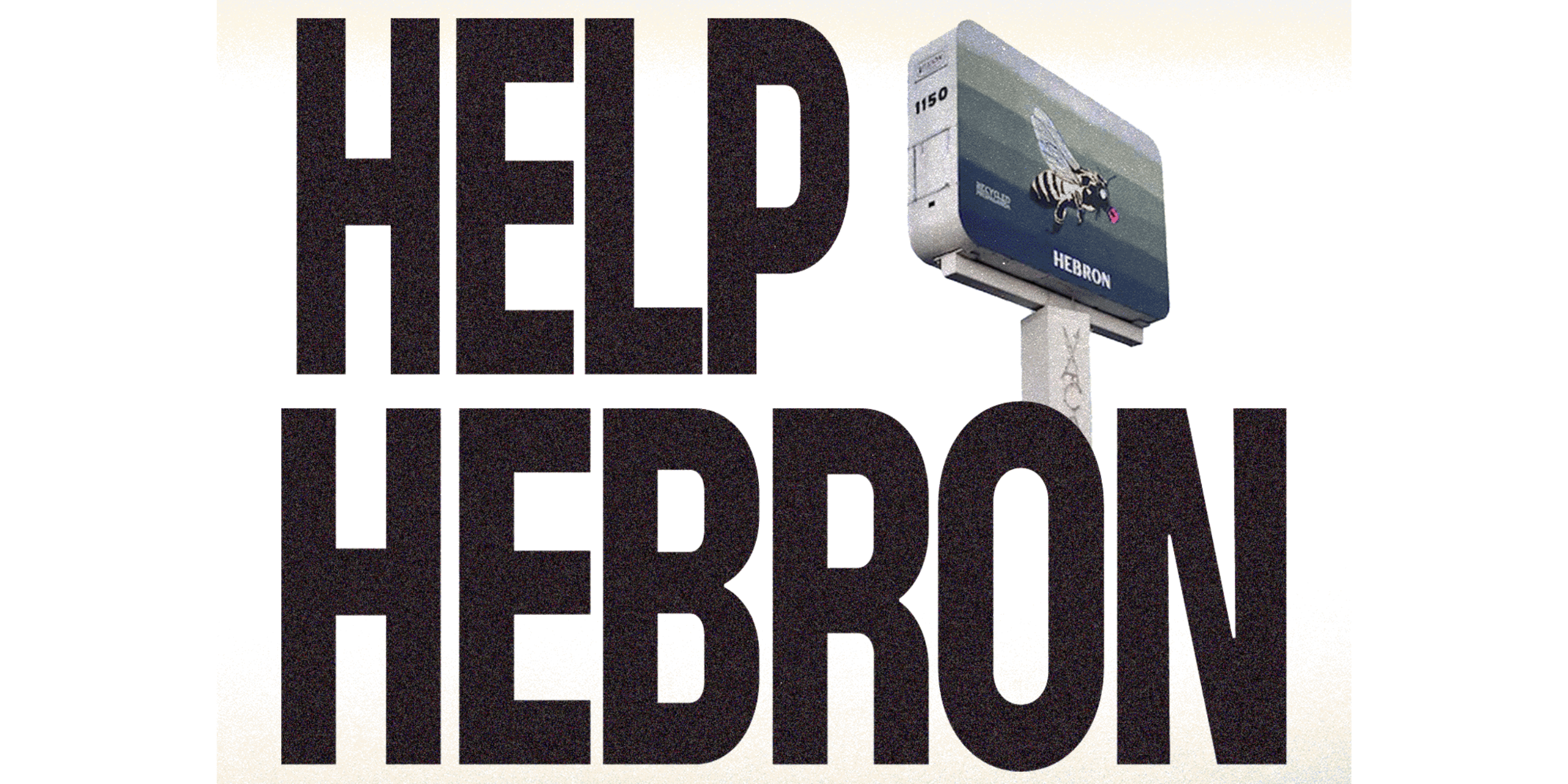
The Las Vegas Democratic Socialists of America (LVDSA) recently responded to a community crisis at Hebron apartments in Downtown Las Vegas, Nevada. Local organizers were outraged to learn that Hebron’s vulnerable residents had been abruptly served eviction notices despite having made timely rent payments. Hebron, a once beautiful neighborhood dedicated to the mission of helping those of low income find affordable housing, formerly adorned with local art and flourishing community garden, has turned into a tragedy as many Las Vegas tenants are looking to their friends and community members asking a vital question: “What is going to happen to us?”
Hebron, “a 124-unit complex”, was originally owned by the nonprofit Caridad to support those who are disabled, unhoused, and unable to work. The complex originally received funding via Tony Hsieh’s Downtown Project Initiative in 2015, prior to the CEO’s unexpected passing, since facing serious financial concerns that led to the nonprofit disbanding its efforts. Hebron apartments are currently managed by Advanced Management Group (AMG) under the supervision of YSBM Investments, and, in our community’s opinion, their management of Hebron has been “inhumane and cruel” toward this vulnerable population. During LVDSA’s involvement, tenants have shared their stories, showing that property management is clearly attempting to push them out of their homes by any means necessary. They have posted illegal eviction notices without following proper due process, locked tenants out of kitchens and laundry services, and removed the nonprofit and community services at the property that were attempting to help tenants facing financial insecurity. Members of our Mutual Aid campaign have been on the property, attempting to provide groceries and community resources, only to be regularly asked to leave by security despite the community’s desperation for food, water, and essential toiletries. Some tenants remarked that the food our Mutual Aid program has provided was their, “only regular access to food.” Most tenants are disabled, without income or transportation, and without the support of the former nonprofit. Many tenants shared with LVDSA that the whole process was “humiliating” and “without dignity”, remarking that their home at Hebron was “the only one (they) knew” and that they had been subjected to “unsafe and unsanitary conditions,” including “going weeks at a time without toilet paper.”
Advanced Management Group recently made a statement to local news in an attempt to maintain positive PR stating that their “priority is stability and support” and that they are “…actively working with local assistance programs, including Help of Southern Nevada…(as they) also continue to provide on-site resources, including a fully stocked pantry that tenants may access as needed,” claiming that “residents who are able to meet standard rental requirements will have the opportunity to remain at the property.”
However, LVDSA has personally been following up with those affected in the past few weeks, and a lot of these claims from management appear highly exaggerated. Help of Southern Nevada, for instance, can only accept clients who are actively living on the street and cannot intervene in individual cases of eviction due to their personal capacity. AMG is also raising the rental requirements to remain at the property. Base rent that was closer to $500 a month per room at Hebron is being swiftly raised to over $800 despite most tenants qualifying for SNAP, placing their economic position to ~130% under the poverty line. Another resident shared with us that the food pantry mentioned “was never restocked” and that the “resources” they were given were simply instructions to The Las Vegas Courtyard, while an essential area of shade for the unhoused, is the socio-economic equivalent of a multiple million dollar company saying to a disabled vet, “We’re so sorry about your situation, but we are buying your home and if you cannot afford it please do go sleep outside and best of luck.”
We are deeply concerned about what happens to the tenants of Hebron if nothing changes. Many tenants shared with us that they are severely disabled, and many are waiting over a year for their Social Security benefit applications to be reviewed. In the meantime, they have no income and are unable to work; many are in need of mobility aids, essential medical devices like oxygen tanks, and expensive medications. Without regular housing, they will likely be completely unable to survive on the street. Most tenants are unable to afford bus passes or walk long distances to reach a shelter at night. Summer is around the corner, and brutal heat waves are already hitting the valley. Extreme desert weather is especially hard on those living on the streets.
Our current economic system not only refuses to hold this kind of systemic genocide of the unhoused and low income accountable, but enables it. This is another situation where, if you are rich enough, lucky enough, and privileged enough, you get to survive, and if you’re not, the elites will take advantage of the opportunity to pinch every last dollar from you until you face death on the street. While this ideology is bleak, I urge you, to paraphrase Timothy Synder’s manual on resisting tyranny-do not look away. Do not look away at the signs of hate in the world that you cannot bear to watch, instead face them, do not allow them to be normal and resist, resist, resist.
The beauty in tragedy like this is the potential for the community to come together and make change. We can do something by getting involved, and we invite you to do the same. Our chapter recently proposed a petition that granted temporary rental assistance to those struggling at Hebron, and we are not finished. Our Mutual Aid campaign is working tirelessly to organize meals, distribute water and hygiene supplies, raise funds to support the tenants, and offer a listening ear to those in need. We will continue to write and share about this issue. Please show the tenants of Hebron that we have not forgotten about them. Below is a list of ways to get involved, make a difference, and send the message: We win together, we cry together but at least we know we’re together.
Please get involved today by visiting: https://lvdsa.org/working-group/mutual-aid/
April 5th, 2026 Update: LVDSA received word from our Mutual Aid Campaign that we were able to coordinate rental assistance and replacement housing for almost every resident left in Hebron Apartments in addition to groceries and hygiene kits. While the community itself may be closing, we are incredibly proud of the response by our community, our organizers and every person who was able to respond to this crisis. Let this be an inspiration that a better world is possible when we respond to the call to action!
River T.F is a local mental health social worker and activist within the community
Sources
Biswas, Akash. 2025. “SNAP Eligibility Criteria 2026: Income Limits & How to Qualify.” Snap Calculator. November 15, 2025. https://snapbenefitcalculator.com/snap-eligibility/.
Carrillo, Jhovani. 2026. “Tenants in Limbo after Nonprofit Operating Las Vegas Low-Income Apartment Complex Is Evicted.” Channel 13 Las Vegas News KTNV. February 26, 2026. https://www.ktnv.com/news/tenants-in-limbo-after-nonprofit-operating-las-vegas-low-income-apartment-complex-is-evicted.
City of Las Vegas. 2026. “Homeless Services.” Www.lasvegasnevada.gov. March 28, 2026. https://www.lasvegasnevada.gov/Residents/Resident-Services/Homeless-Services.
HSNV. 2026. “‘See If You Qualify.’” Help of Southern Nevada. March 24, 2026. https://www.helpsonv.org/.
King, James. 2026. “Hebron Residents Fear Eviction, Uncertainty as Fallout from Management Change Continues.” KSNV. March 3, 2026. https://news3lv.com/news/local/hebron-residents-fear-eviction-uncertainty-as-fallout-from-management-change-continues.
Ohio State. 2026. “Caseworkers: Overworked and on the Decline | EPIC.” U.osu.edu. March 24, 2026. https://u.osu.edu/epic/2020/12/07/caseworkers-overworked-and-on-the-decline/.
Shelley, Berkely. 2026. “Annual Comprehensive Financial Report (ACFR) Fiscal Year Ended June 30, 2026 Budget.” Lasvegasnevada.gov. LVNV. https://files.lasvegasnevada.gov/finance/2026_Fiscal_Year/CLV-FY2026_Final_Budget.pdf.
Snyder, Timothy. 2021. ON TYRANNY GRAPHIC EDITION : Twenty Lessons from the Twentieth Century. S.L.: Ten Speed.
Southern Nevada Regional Housing Authority. 2026. “Open Section 8 Waiting Lists in Las Vegas, Nevada.” Affordablehousingonline.com. 2026. https://affordablehousingonline.com/open-section-8-waiting-lists/Nevada/Las-Vegas.
T.F, River. 2026. “Discussions with Residents.” In person interviews, March 20, 2026.
Torres-Cortez, Ricardo. 2026. “Officials Rush to Rescue Las Vegas Tenants from Sudden Rent Hikes, Evictions.” Las Vegas Review-Journal. March 21, 2026. https://www.reviewjournal.com/news/politics-and-government/las-vegas-and-clark-county-officials-rush-to-rescue-hebron-tenants-from-sudden-rent-hikes-evictions-3727689/.
Urban Institute. 2017. “Public Welfare Expenditures.” Urban Institute. October 20, 2017. https://www.urban.org/policy-centers/cross-center-initiatives/state-and-local-finance-initiative/state-and-local-backgrounders/public-welfare-expenditures.
Gwinnett Begins Organizing!
Atlanta DSA Interest Meeting Held in Lawrenceville
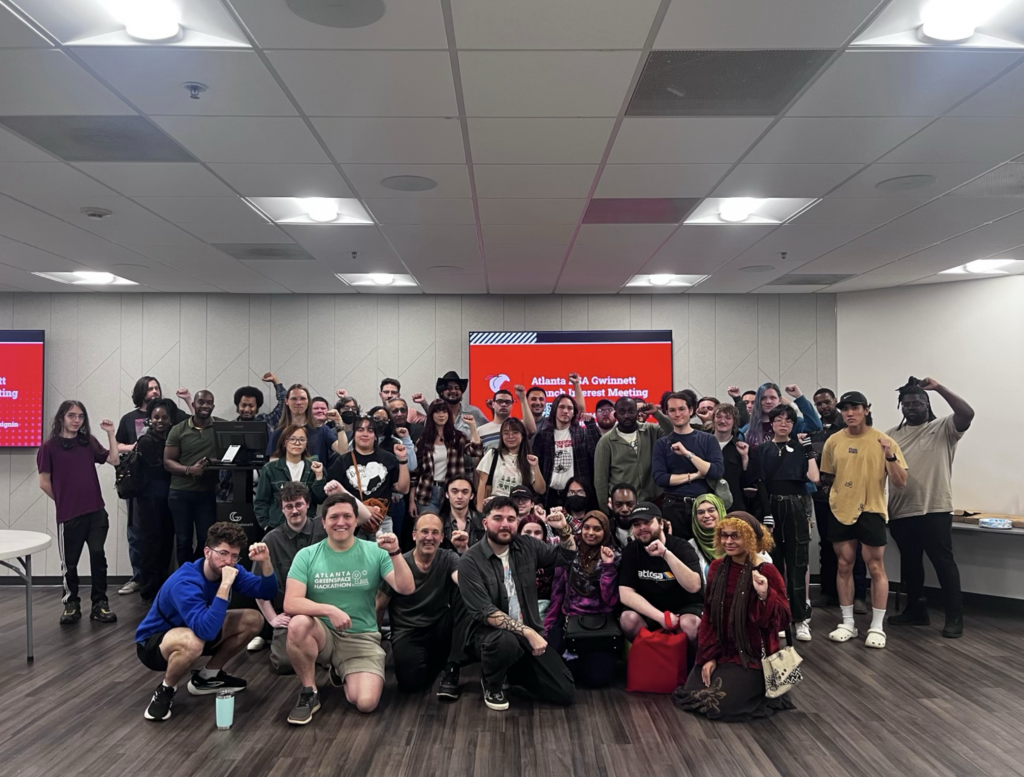
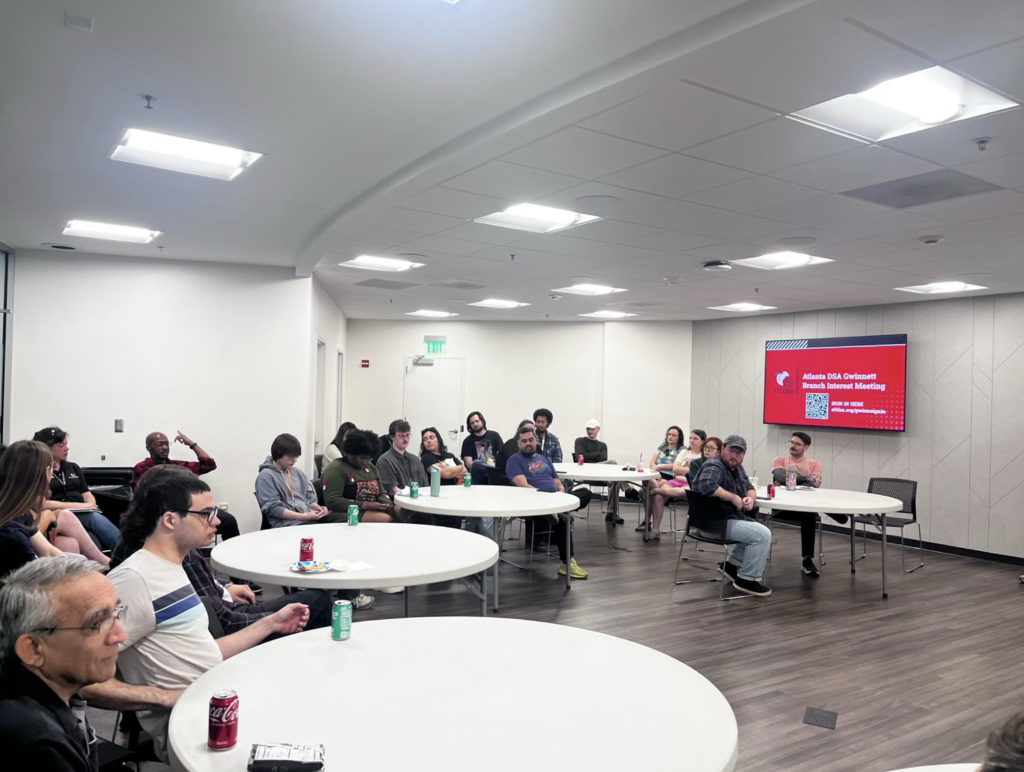
In July of 2024, the metro-Atlanta county of Gwinnett officially became the second county in the state of Georgia to cross the mark of one million residents, behind only Fulton County, home to Atlanta itself. This growing population indicates that Gwinnett needs an Atlanta DSA branch of its own to promote socialism and to act as a vehicle for the voice of Gwinnett’s working class in metro Atlanta’s political sphere. Thus, on the afternoon of Sunday, March 7th, 2026, Atlanta DSA organizers, with the help of Georgia Gwinnett College’s YDSA (GGC-YDSA), held a Gwinnett branch interest meeting, which was attended by well over 60 people at GGC. A petition to formalize a Gwinnett branch has been underway since.
The meeting began with attendees sharing what drew their interest in the DSA and a few common sentiments rang throughout the 60+ gathered. Some of those sentiments included healthcare costs, taking political action for Palestinian liberation, wanting to act against growing right-wing power, and making life affordable in Gwinnett. Another common sentiment was that of a previous desire to be involved with Atlanta DSA, but distance to the city made that desire difficult to actualize.
Following introductions, the meeting changed gears to explaining the DSA structure to attendees. Much of the emphasis was put on the DSA’s nonprofit, volunteer-run system and how it functions bottom-up rather than top-down, as is the status quo for political organizations in this country. The meeting leaders also highlighted the DSA’s electoral strategies, with focusing on grassroots level matters, as exemplified by the recent successes of Kelsea Bond and Gabriel Sanchez in the state of Georgia. Following that, information about Atlanta DSA’s different committees (labor, political education, electoral, etc.) and identity-based sections (Afrosocialists and socialists of color, feminist socialists) was shared with the attendees.
As the meeting came to its conclusion, the group discussed how DSA works with other working-class organizations in the Atlanta area to advocate for the improvement of working class life, emphasizing DSA’s collaborative structure, especially during this period of right-wing fascism attacking the working class and the country’s minorities. Finally, at the meeting’s end, the petition to start a Gwinnett branch of the Atlanta DSA was introduced.
I spoke to two members of GGC’s YDSA leadership, co-chair Josue EC and membership chair Hannah B, who both worked to host the Gwinnett interest meeting. Josue worked to arrange the meeting location, design the flier, and to promote the meeting on the GGC campus and through social media. When asked about what he hopes to see happen through a Gwinnett branch of Atlanta DSA, he expressed that he feels that the current system of elitist American politics pushes members of the working class away from engaging politically. Thus, through a Gwinnett branch of ATLDSA, he hopes to energize leftists across the county to become politically engaged and bring about positive change in the lives of Gwinnett’s working class. Hannah B, who also helped in organizing the interest meeting, spoke about how she hopes a Gwinnett branch will work to bring socialism locally to Gwinnett, not just limited to the city of Atlanta. One specific goal she she shared is for a Gwinnett branch to push for low cost/free public transportation in Gwinnett, which would include the expansion of MARTA.
The meeting had a very positive and optimistic outlook to it, as the people of Gwinnett are hungry for real, meaningful change and are excited to engage with DSA to bring about such change. The people of Gwinnett are hopeful that in the face of right-wing fascism and elitist politics, a future Gwinnett branch of ATLDSA will advocate for immigrant rights, affordable housing, free healthcare, and local support for Gwinnett’s working class.
May the future of the DSA in Atlanta be prosperous and may the people of Gwinnett carry their hope towards a future of well-being, safety, and health.
The post Gwinnett Begins Organizing! appeared first on Red Clay Comrade.

Rapid Response Form
Purpose
This procedure is intended to assist Milwaukee DSA in effectively responding to and promoting actions and events when there is not time to meet beforehand.
Procedure Steps
- Within two days of notification of a new event:
Someone (in membership) alerts the rapid response body (Outreach Officer), who will determine whether we will promote DSA attendance or decline to promote.
If Outreach decides to promote, proceed. If Outreach declines to promote, announce in discord that we are declining to promote this event for DSA attendance. Announce that this does not mean DSA members shouldn’t attend, it only means that we are not showing up organized as DSA.
- If vote is to promote:
Create a thread in discord (under #emergency-actions) to coordinate people, title this thread as descriptively as possible to this one event (Event title + date).
Announce in #general-announcements that we are promoting DSA members attendance and link the event coordination thread in this announcement.
Assign an event coordinator who will be responsible for performing setup and communications for the event.
- Before the event:
Event coordinator will pick up supplies from Zao MKE:
DSA banner or flag
Sign-in sheet (if possible)
Sign-up QRs, petitions, etc. in rapid response bin (will need to be put together)
Five clipboards for canvassers
Event coordinator will transport the supplies to the event and arrive at least 15 minutes prior to the event start time.
Event coordinator will announce a meetup point in the event discord thread.
- During the event:
Event coordinator will stay at the meetup point for at least 15 minutes after the event start time.
Event coordinator will assign and distribute literature/petitions to members who are willing to canvass.
Event coordinator will be responsible for carrying DSA banner/flag.
Event coordinator will maintain a unified body of DSA members that moves together, the exception to this rule will be the assigned canvassers.
Event coordinator will monitor the discord thread for the event for the duration of the event.
- At event close:
Event coordinator will collect all materials from canvassers.
Event coordinator will take a photo of the DSA group.
Event coordinator will return materials to Zao MKE.
Event coordinator will separate filled-out petitions and label them with the event title and date on a scrap piece of paper folded around the petitions.
Event coordinator will return sign-in sheet to chapter secretary.
In the News: Las Vegas democratic socialists aim to put ‘people over profits’ in Assembly primaries

Capping rent increases, increasing the minimum wage, and banning corporate money in politics are just some of the issues two democratic socialists are advocating for in their campaigns for state Assembly.
The Democratic Socialists of America (DSA) received national attention due to Zohran Mamdani’s victory in the New York City mayoral race in November 2025, as the schism between the progressive and establishment wings of the Democratic party deepens over how to engage with working class voters after failing to defeat Donald Trump in the 2024 presidential election. Mamdani openly described himself as a democratic socialist throughout the primary and general election and is a member of the New York City DSA.
Here in Nevada, Assembly candidates Shaun Navarro and Val Thomason do not shy away from the label. Both are members of Las Vegas Democratic Socialists of America, or LVDSA, which is a political activist organization, not a political party..
“Rich people tell us what to do at our job, they write our laws,” Thomason said. “We don’t even have control of our own tax money.”
Democratic socialism to her is taking control from the rich and giving it to the working class.

RVDSA Adopts Chapter Electoral Strategy